Sunday, June 16, 2013

Judge & Jury: What It’s Like to Judge at a Wine Competition

Lucky me, I judge at wine competitions. But I routinely get comments that run the gamut from, “I’m jealous,” to, “Michael, do you actually work for a living?” So to quash the misinformation about wine judging, I’m putting a cork in several myths. Within the State Fair system I have judged at the California State Fair, the El Dorado County Fair (known as the Mountain Democrat Wine Competition), and the Central Coast Wine Competition (part of the California Mid-State Fair) which is a competition of wines from several counties including Santa Barbara, San Luis Obispo and Monterey, and several other fairs. So, here’s what you need to know.

Myth #1: Wine competitions are just a chance to drink lots of wine.
Actually, no one drinks wine at wine competitions. Judges evaluate between 60 to 90 wines a day, giving full attention to each wine - a time consuming and focused endeavor. We smell them, swirl them, then spit them into dump buckets. What develops is palate fatigue, whereby you’ve had so many wines that your taste buds need a break. Each panel has a plate of celery, olives, bread, cheese and sliced beef available to help cleanse the palate. And a day’s work can mean tasting through 15 Cabernet Sauvignons, then 30 Chardonnays, 20 Pinot Noirs, 18 white Rhone blends, 4 dessert wines and then 7 sparkling wines. Yes, it’s taxing physically, but also mentally as we try and be fair to each wine, from the first few to # 89.
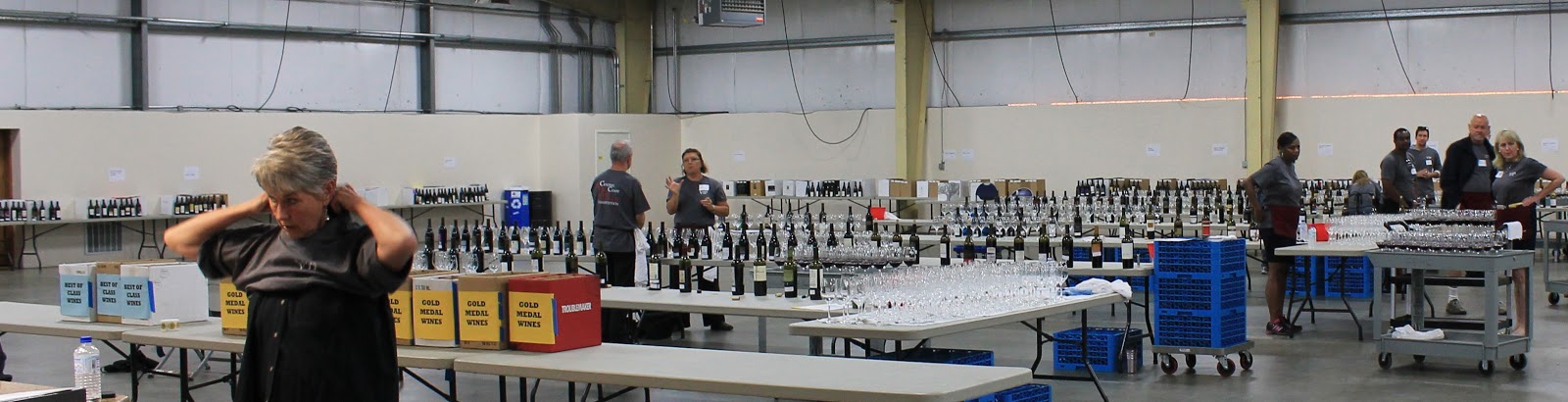
The back room - where judges aren't allowed
 Myth # 2: Wine judging is rigged.
All wines are tasted blind and a dedicated volunteer staff catalogs, opens, pours, numbers and delivers wine in glass to judges so we have little information about the wine – we don’t want to prejudice the outcome. We usually know the variety, perhaps the vintage date, but most other information is left with the volunteers behind closed doors. And this is exactly how a wine should be evaluated. I can attest that some wines win awards and when we find out the producer, we’re surprised, and yes, sometimes embarrassed because we think it’s a wine we would never have purchased on our own. But that’s what is so cool. Most competitions allow us to give a wine a gold medal, silver, bronze, or the dreaded “no award.”


Myth #3: Wine “judges” are a bunch of people who know little about wine.

Doug Frost (foreground)  doing his thing
Wine competition judges are comprised of professionals in the wine industry, like; winemakers, wine retailers (specialty wine shops and wine buyers for mega-stores and restaurants); wine media (seasoned wine writers for newspapers, magazines, websites, radio, and blogs) and folks in the culinary world. For example this year (2013), the Central Coast Wine Competition had judges like Doug Frost from Kansas City, one of the most respected sommeliers and wine educators in the U.S, and one of only four people in the entire world to hold the duel titles Master of Wine, and Master Sommelier. And William Bloxom-Carter, the executive Chef and food and beverage director of the Playboy Mansion in Los Angeles, a position he’s held for nearly 30 years (and if you think his job is cutting celery sticks for Playboy models, you’re dead wrong. Chef Carter plans and executes tons of dinners often time for over 1,000 people). At the California State Fair the pros included Joe Roberts (from Philadelphia) and Robert Jennings, two of the biggest wine bloggers, to winemakers like Leslie Renaud (from Santa Barbara), and Jackson Starr (from Grass Valley). In Placerville this year there were judges like Mike Dunne, the former wine and food writer for the Sacramento Bee for 30 years, to Charlie Tsegeletos, the longtime winemaker at Cline Cellars in Sonoma. So it’s a safe bet we know wine.


The Judges of the Central Coast Wine Competition

Myth #4: No one cares about awards and scores.
Think what you like, but a gold medal at a competition translates to sales, bragging rights and marketing potential. Judging is made up of multiple panels and each individual panel consists, usually, of three judges. It’s important to know that gold, silver and even bronze medal winning wines receive their medals by these panels, not an individual. Double Gold awards (meaning every judge on a panel gave it a gold medal) and Best of Class wines are voted on by an even larger panel, ranging from 20 to 70 people. Of course not all judges agree and I’ve sat on panels where wines I’ve loved have not been loved by my peers, and vice versa. But beyond that, for people like me as a wine writer, even for judges who work in the retail environment, we get to discover new wines, new wineries and promote them.
 
Wine Judging Ain't All Glamerous
County fair wine competitions are held in unglamorous settings, usually a big warehouse-type building. Sure, other wine competitions are at nice restaurants or places like Fort Mason overlooking the San Francisco Bay but the state fair system is pretty much nuts and bolts and nothing fancy. Another thing to know is that each competition has a chief judge who oversees all the other judges, makes decisions and solves problems. And there are the volunteers, all those folks who go unheralded and work the backroom to help everything run efficiently. For example at the California State Fair in Sacramento, we had 75 judges, 100 volunteers and 2,600 wines. Do the math. At the El Dorado County Fair Wine Competition they have a special award known as the Backroom Award, whereby the volunteers give out an award for their favorite wine, which is a pretty cool thing to do. So the next time someone you know is off to a wine competition, you’ll have a better understanding of what we do and when you see a medal winning wine, you’ll know that a lot of work has gone into it, so give that wine a try. And stop by your local county fair, or one of these.

Me, Having Fun


Sunday, June 2, 2013

A Santa Barbara Beer Dinner


I am a beer advocate. I am not, however, an insatiable beer lover, a hop-head, a fanatic. I’m more of a wine guy so when a beer pairing dinner, one of Santa Barbara’s first, was announced with Firestone Walker Brewing Company, and Chef Budi Kazali of The Ballard Inn, well, that was a no-brainer. I had never been to a beer pairing dinner before, but have certainly been to my share of winemaker dinners over the years.

Wine pairing dinners are so common these days that here on the Central Coast you can find one everywhere you go, be that Santa Barbara, Santa Maria, Pismo Beach, Paso Robles and Cambria. But surprisingly beer paired dinners are less common, though if you’re in micro-brew hot spots like San Diego or Seattle you can find a number of them. But they are starting to catch on in Santa Barbara. 
 
With over a dozen microbreweries in the region there should be several to choose from every year, but sadly, that hasn’t happened yet. More often beer dinners tend to be paired with pub and tavern food and that’s not a bad thing, but this beer dinner helmed by Budi Kazali meant that the food, and therefore the beers were elevated to fine dining – though still rambunctious what with a total of six beers.

The dinner was not created from a vacuum, actually the idea was prompted by American Craft Beer Week, a nationwide event celebrating the 2,800 small craft breweries who participated in events across the U.S. Budi choose the beers he wanted to work with, choosing less hoppy brew since bitter overly hopped beers don't pair well with most foods.

A brief run down of the menu is as follows:
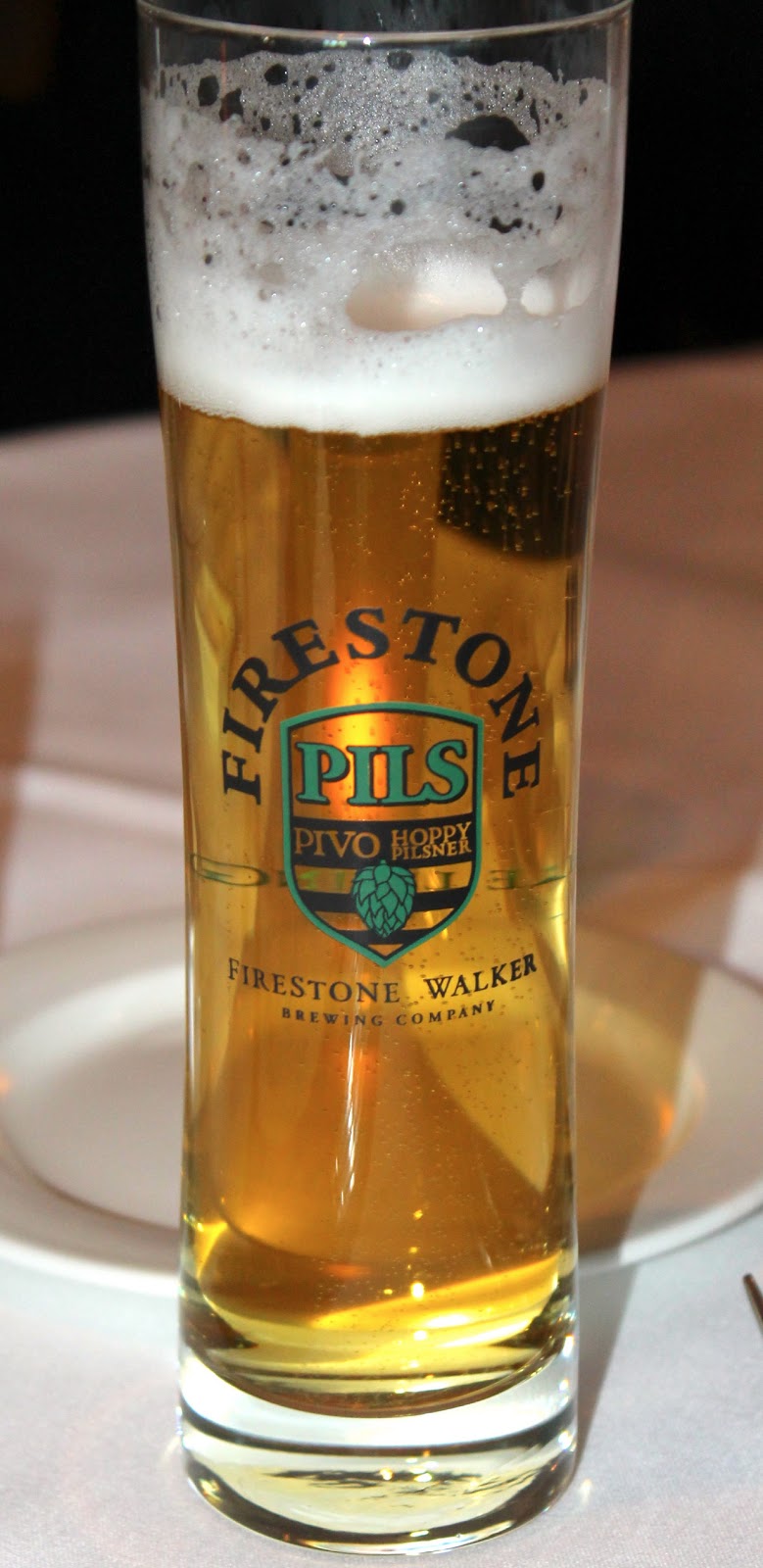
1st Course: Tempura shrimp in a green papaya sauce, seared scallop in a saffron sauce, and seared tuna in a yuzu vinaigrette, served with a glass of Firestone Pivo Hoppy Pilsner, a classic Czech pilsner with only 40 IBU, so it’s actually not over hoppy. What was surprising was to see this beer work across such diverse flavors as these three bites that Budi created.
2nd: Crispy skin sea bass with the Firestone Lil Opal Barrel Fermented Saison which uses wild yeast aged in Opus One (a high-end Napa winery) barrels which has a light sour finish paralleling the crispy sea bass and the lemony tart sauce Budi crafted for the fish.
 
David Walker discusses his beers with guests
3rd: Kalua Duck, jicama salad with a Chinese black bean sauce with Firestone Unfiltered DBA, an English pale ale just slight hoppy which registered most obviously to me with the earthy mushrooms in the crisp jicama salad.
4th: Kobe beef short ribs (and stunningly tender) with a coconut sauce with the Firestone Rufus Wild Ale, a brew aged in 23 year old bourbon barrels. And here the almost sweet sense of the bourbon coaxed out the richness of the ribs.
Chef Budi Kazali
5th: Coffee pot de crème with bourbon whipped cream paired with one of Firestone’s best brews, the Parabola Bourbon Barrel Aged Imperial Stout. Long ago the Russian royal family seemed to love stouts but they wanted a kind of turbocharged version as David Walker put it. So, more hops, more alcohol and the Imperial was born. The Parabol was aged 9 to 13 months in barrel and it that kind of deep, rich earthy beer that completely stands on its own. Having been at this dinner it begins to ignite thoughts about experimenting at home. Beer and wine are food products and therefore should be an integral part of mealtimes (sure, breakfast works too) and what is exciting is realizing the endless possibilities to find flavors, textures and viscosities what work together to make a meal memorable.
 
So if you live in Santa Barbara or are planning a visit check out the brews of Firestone Walker – they have taprooms in Buellton in Santa Barbara, and one in Paso Robles – and make reservations for dinner at the Ballard Inn for some of the best food in the county – you can stay here too for a wine country, er, beer country getaway.

Friday, May 3, 2013

Hiking Santa Barbara


Easy paths at the Carp bluffs
Santa Barbara presents a diverse topography for hikes, from ocean bluffs to front country to the rugged back country. These three hikes give you assorted scenic vistas, a moderate workout and great photo ops. Plus none are too far from downtown. A note on hiking here in Santa Barbara, and all along the Central Coast: Yes, we have poison oak so always be cautions when going off trail. It’s called poison oak but it can’t kill you but rest assured, as a native Californian and having had my share of it – it ain’t fun. Even as of this writing I contracted some on my left leg while hiking in Big Sur. Always bring water, hat, cell phone, and sunscreen when you hike. My small pack also includes a knife, and nuts for protein, just in case. So get packed and get going!
The views from the bluffs

Coastal
The Carpinteria Bluffs and Seal Rookery is less hike and more easy stroll on soft dirt paths, and the bluffs are a great beach excursion across eucalyptus-studded groves heading to the water. It’s only a mile out and a mile back, but this coastal walk is perfect for any age and fitness group, in fact the elevation gain is like 2 feet. The scent of chaparral meets you as you pull into the parking lot with low grasses and shrubs in front of you. There is also access down to the beach, however part of the beach is closed off December 1 through May 31 during birthing and nursing season for the harbor seals who seem to think mating in public is just fine (showoffs). While there, they are noisy but fun to watch. Located right off the freeway this is immensely easy to get to and gets you to views of both the ocean and the mountains and gets you to the water’s edge while still feeling like you’re in a preserve. That feeling is briefly interrupted by crossing the train tracks, but as long as there are no actual trains in your way, it’s all good. You might see whales and dolphins, certainly plenty of sea birds (not on the train, on the hike). To get there exit Bailard Ave. from Highway 101 north or south and head to the ocean. There’s a small parking lot right in front of you.
The views from Tin Can Meadow

Front Country
Rattlesnake Canyon is one of the more popular hikes and is fairly easy, and no, you won’t come across any rattlesnakes since it was named for its serpentine canyon. This is a well-marked trail and is less than 4 miles in total. You’ll pass by pools, streams and eventually come out the top of a small hill with panoramic views to the ocean and the Channel Islands. From Los Canelos Road near the Santa Barbara Botanic Garden it’s just over 1 mile to the second stone bridge where there is ample parking before and after the bridge on the road pullouts. Starting on the trail it feels like you’ve been jipped – it’s hot and dry and uninteresting. After 10 minutes on the trail there’s a short incline where you encounter two oak trees - go left (going right is a short trail, nothing exciting). 
Never know what's  you'll find on Rattlesnake trail
You soon hook up with the creek in a wooded area then cross the creek and head up into sheer diversity. You'll likely see grey squirrels and wild bunnies (not mean, just wild). It will take you 40 minutes at a moderate pace to reach Tin Can Meadow, which is a great turnaround point. There’s a flat rock there where you can sit for a while, surrounded by tall grass and absorb the beauty before heading back. There is a terrific diversity of stuff here from multiple stream crossings to wooded areas to open narrow trails, moss covered boulders, pine and oak trees, low scrub and thick trees. With an elevation gain of 900 feet it’s also a decent workout.
The rocks, ocean and Islands from Lizard's Mouth
Back Country
Lizard’s Mouth (West Camino Cielo Road) For a completely different experience, head to Lizard’s Mouth, so named for the unusual sandstone outcroppings – though not sure how a lizard affected this. On the south facing slopes of the mountain with panoramic views of all of Santa Barbara and Channel Islands (and quite possibly China…well maybe not) this a sea of wondrous boulders, curvilinear smooth sandstone, as if sculpted by hand, windswept and eerie. Take Highway 154 up from Santa Barbara 7 miles to West Camino Cielo and turn left. Follow the road 4 miles to the Winchester Gun Club entrance. Turn around here and on your right had side, about 100 yards back down the road you’ll see a graffiti sprayed brown wooden sign, about 20 feet off the road. There are no real paths here you just wander in between large boulders and on top of sandstone flats. Some boulders you can walk underneath and you swear they might collapse on you. It almost looks like a movie set and Lizard’s Mouth has an otherworldly moonscape feel to it. It’s easy to get lost so keep an eye on where you came from. Small trails head out to, and in-between, the rocks, some with small crevices and near cave-like entrances. It’s pretty much rock hopping out here. It's a little disconcerting to hear the gunfire from the Winchester Gun Club up the road at first, but you're perfectly safe. Weekdays are better as it’s less crowded.
For a totally different hike, check out my post about the Arroyo Hondo Preserve


Friday, April 12, 2013

Murder at the Mission: The Haunting at San Miguel

-->
When Mission San Miguel was founded on July 25, 1797 just north of Paso Robles, the founding fathers could never have imagined the terror that would occur at this sacred site just 49 years later. The scene of a horrific murder, many people believe this mission is haunted. We may not know about ghosts, but here’s what we do know about that cold December night. The original temporary church built in 1797 burned in 1806, and a stone foundation church was completed in 1821. After Mexico fought against and won their independence from Spain, the Mission system began to collapse and by 1834 the Mission had become secularized. On July 4, 1846, Petronillo Rios and his business partner William Reed purchased the floundering mission for a few hundred dollars, operating it as a lodging and trading post and Reed and his family lived there. Reed, usually wearing a blue peacoat, required that guests pay in gold, and he bragged that he’d amassed a small fortune, hiding it somewhere at the mission. Remember that California was not part of the U.S. at this time and any currencies from Mexico, the U.S., and even money from Spain were probably considered worthless. Gold was what mattered.

On the afternoon of December 4th, 1848, six men arrived at Mission San Miguel. Pete Raymond, Joseph Lynch, Peter Remer, Peter Quin, and Sam Bernard, accompanied by someone only known as “John,” an Indian from Soledad. They stayed that night but left the next morning heading south to San Marcos Creek just a few miles down the road but then they returned to the mission and spent the rest of the day and part of the evening there on December 5th. It was during these early evening hours that this gang of cold-hearted men murdered everyone at the Mission including William Reed and his wife, Maria who was expecting a baby, and their 4-year old son. Also killed was Josefa Olivera, Maria’s mid-wife, and 3 other children; 11 people in total. The men had been warming themselves near a fire when Bernard offered to go outside to get firewood. He returned with an axe hidden in his armload of wood and struck Reed several times while John the Indian stabbed him with a knife. Sam Bernard and the others stalked and killed the women and children, then took the bodies to the carpenter's shop. When their blood-drenched bodies were were found they were still wearing daytime clothes.

Based on the interrogations of Joseph Lynch, Peter Quin and of Peter Remer, this is what happened that cold December night. After the ruthless murders they drank wine stealing any valuables they could find, which wasn’t much, ransacking the place in search of Reed’s gold – but they never found any. They left the mission that evening and spent the rest of the night south of present-day Templeton, and spent the next night south of Mission San Luis Obispo, but by this time a posse had been formed and was tracking them. What they didn’t know was that on the very night of the killings, a man named James Beckwourth was carrying mail from Nipomo to Monterey when he stopped at the mission and discovered the bodies. Shocked, he rode on to Monterey and informed the military governor of the murders. The gang left San Luis Obispo and traveled down to the Los Alamos area and obtained, we presume, fresh horses at a ranch. They rode through Santa Barbara stopping at Rancho Ortega, at present day Summerland, where the posse caught up with them, but this was not to be a bloodless arrest. Sam Bernard was mortally wounded. Pete Raymond jumped into the surf attempting to escape, and was drowned. Peter Quin was wounded and captured having killed a member of the posse; Joseph Lynch and Peter Remer were also captured, and later confessed to their parts in the murders. John the Indian had peeled off from the group around San Luis Obispo and was never found. 

The chapel interior
Reed’s partner Petronilo Rios, helped bury Reed and the other victims in the cemetery of Mission San Miguel, “just outside the rear door of the sacristy; a little to the southwest and near the old first church wall,” according to one account. All 11 people were buried in one mass grave and it must have been a disturbing sight seeing the bodies of the children.
Lieutenant Edward O. C. Ord (Fort Ord in Monterey was named after him) from Monterey and nine soldiers were dispatched to Santa Barbara to act as a firing squad.

According to accounts Joseph Lynch, Peter Remer and Peter Quin were executed by firing squad in Santa Barbara on December 28, 1848, near the corner of De la Guerra and Chapala Streets. Reports said they were buried in the cemetery of Mission Santa Barbara, but that seems highly unlikely that they would have been buried there considering the murderous acts they had committed at Mission San Miguel. At any rate, following the murders Mission San Miguel converted rooms into a hotel, saloon, and retail shops. Over the years many people have claimed they have seen the ghosts of William Reed, wearing his peacoat and a lady in a white dress around the mission grounds. 

Some swear they have heard muffled screams coming from near the chapel, and images of the young boys who were killed that night. Are ghosts real? And do the tortured souls of innocent victims attempt to make contact with the present world? Is the gold still there, or was it ever there? Does William Reed and his wife, Maria call out from their graves? That’s for you to decide. Perhaps when you visit Mission San Miguel you might find the answers.


Watch my “2 Minute Travel” video shot at Mission San Miguel at midnight: GHOSTS OF THE COAST


Saturday, March 16, 2013

Arroyo Hondo Preserve: Hiking Through Time


I am not a botanist. Nor do I pretend to know much about native plants, habitat restoration, or land use regulation. Regardless I committed to a 10-week program of habitat restoration at the Arroyo Hondo Preserve along the Gaviota Coast; that stretch of sun baked coastal land which extends from Santa Barbara out to where Highway 101 turns inland. This 30 mile stretch is one of the last un-spoiled tracts of coastal land in California and is a multitude of agriculture pasture lands, canyons and pristine beaches.

At 782 acres the Arroyo Hondo canyon looks deceptively small. The earliest known inhabitants of Arroyo Hondo were the Barbareno-Chumash civilization going back about 5,000 years. When Spanish explorer Juan Rodriguez Cabrillo sailed through the Channel in 1542, his team recorded a camp of the Native Americans located here at the mouth of Arroyo Hondo creek. Just 227 years later when the De Anza expedition actually walked this area, the village at Arroyo Hondo was abandoned. Of course the arrival of the Spanish spelled doom for the Chumash, maybe they understood that.

Rancho Arroyo Hondo was part of the original 26,530-acre Rancho Nuestra Señora del Refugio Mexican land grant to former Santa Barbara Presidio Commandant Jose Francisco Ortega in 1827 – that’s quite a gift by today’s standards. Only three families have owned this land since the Chumash first inhabited it and the adobe house on the property was built in 1842 by the Ortega family and was used as a stagecoach stop on the route between Lompoc and Santa Barbara in the late 1800s and the old road (since there was no freeway or railroad crossing) passed by the adobe. There is a small museum inside, two rooms actually, mainly photos and a few scrapbooks providing some history. 

Undoubtedly because of the narrow canyon at Hondo and its streamlined views down to the road it became a refuge for outlaws including Joaquin Murrieta, known to have murdered at least one man (Murrieta was killed by a posse in 1853 at his headquarters near Coalinga), and Jack Powers who terrorized travelers after the gold rush. Therefore you have the aptly named and best hiking trail here- The Outlaw Trail which takes you from the mouth of the canyon far up into the mountain with killer views. The trail is really two parts, a low key stroll through Hollister meadow and a slight incline which stops at a small grass clearing. Housed there is a wood picnic table placed strategically so you can rest and enjoy ocean views. If this seems taxing, don’t bother with the rest of the trail. From here it ascends sharply into the mountains and you leave behind the lush meadow by the stream and as you ascend the vegetation becomes more sparse, low to the ground, the heat becomes more pronounced, and the land more unforgiving.
Views along the Outlaw Trail

Heading up the Outlaw Trail you pass through successive layers of rock formations, some estimated to be about 40 million years old. At the top are sweeping views and a cool malformed sandstone outcropping looking more like Swiss cheese with holes and tunnels permeating its core, where you can stand and feel like you own the whole world. The views to the Pacific and the Channel Islands are unsurpassed. It’s just you and the random hawks and turkey vultures who silently soar above you. To your left is the Tajiguas landfill (which one local paper described as the “prettiest and most expensive landfill” in the tri-counties) and the peculiar juxtaposition of two canyons, one a nature preserve and one a garbage dump, is amusing, if not a little sad. But then that’s exactly the point of keeping Arroyo Hondo in perpetuity. This canyon won’t end up being a dumping ground for our insatiable need to waste things.

Looking down the canyon from the top of Outlaw
During my 10 weeks at the preserve I weeded, hoed, planted “native” plants under the direction of botanist Darlene Chirman, weeded again, mulched, watered, and tediously weeded again. I was curious about restoration, after all, what are “native” species and how do you track a chronology of plants? The rule of thumb in California is that native plants refer to plants here prior to the arrival of the Spanish and the goal is to bring Hondo back to that close approximation. Once the Spanish came they began cultivating the land with seeds and cuttings from Spain and Mexico, forever altering the landscape. It seems futile in some regards to get back to that point in time, and certainly with ubiquitous weeds piercing through the ground and the constant effort to root them out, it’s a perplexing task. But if left unchecked, this preserve, along with the plants and animals like mountains lions, newts, birds and fish that have long called this place home, would suffer from a changing landscape forcing them to retreat elsewhere.
Volunteers doing their thing

Perhaps that is the obvious nature of evolution and we should not try and maintain a piece of land, memorializing it from its heyday. Perhaps evolution demands we let nature take its own course, and that’s a viable argument. But after 10 weeks here I realize that we humans are stewards of this planet and the animals and plants in it. The work that restoration volunteers do here may not stop nature from what She wants to accomplish, but they are helping to preserve Hondo as it was before Westerners came along. The hope is that this place of natural beauty and history will inspire others, and that, regardless of what might happen with building codes, zoning laws and property rights, this valuable section of the Gaviota Coast will remain unspoiled and available to everyone.


Hondo is open the first and third weekends of each month. There are free docent led hikes the first Saturday and third Sunday of every month at 10 a.m. There’s no cost to visit, but donations are gladly accepted. Advance reservations are required – simply do this on-line – as a way of knowing who comes out, in part because the gates get locked and you don’t want to be stuck here. From Santa Barbara north on Highway 101 Arroyo Hondo is four miles past Refugio State Beach. Look for the blue CalTrans call boxes spaced one mile apart on the right hand side of the highway. The Arroyo Hondo entrance is located immediately after call box 101-412.   ARROYO HONDO PRESERVE