Thursday, March 1, 2012

Santa Barbara Sweet: Cocoa, Chocolate & Consumption


I don’t know anyone who doesn’t like chocolate. One of the favorite foods of our forefathers, who established this plot of heaven on the California Central Coast, was and continues to be, chocolate. Cocoa came to Alta California from Mexico transported on the backs of donkeys and Spanish padres. But these days you don’t need to work that hard to find exceptional chocolate.

Cocoa Then       
Chocolate was an integral staple of the Missions, from present day Texas, to Sonoma in California. Local Mission documents from 1779 through 1810 record the important use of chocolate and the padres routinely drank hot chocolate first thing in the morning before breakfast. Even father Junipero Serra, who founded Mission Santa Barbara, wrote about chocolate in the early 1770s. At the Santa Barbara Presidio residents had a variety of spices available to them and requisition records show that among the requests were cloves, saffron, cumin, and anise - coffee wasn’t requested until 1805. But chocolate was constantly ordered in large quantities and was asked for specifically from Caracas and Tabasco, Mexico, telling us that the concept that every place produces a product specific to its inherent ecology. There were specific pots associated with chocolate, many with locking lids due to the value of the cocoa it contained. The jerro chocolatero pots were made from copper and used to heat, then whip the chocolate into a drink. 
Copper Cocoa Pot

Chocolate Now
These days chocolate is easier to come by and Santa Barbara is home to four chocolate shops. Maya Schoop-Rutten learned chocolate making in her native Switzerland and her Chocolate Maya store, the only place she sells her chocolates, opened in 2007. She not only carries chocolate bars from places around the world, but the confections behind the glass are handmade by her using fresh local herbs. She hand decorates each individual piece and seeks out fair trade practices from whom she buys her bulk chocolate, and even travels to cocoa plantations across the globe to see for herself where the beans come from. “I need to know the origins of my chocolate,” she tells me. Her hand made chocolates are $2 a piece and imported chocolate bars range from $2.50 to $15 depending on origin and rarity.
Chocolate Maya and Maya Schoop-Rutten
Say chocolate in Santa Barbara and most people think Jessica Foster Confections. Foster started her company after working as a pastry chef at Bouchon. She has no formal training but has created a very successful business. Her truffles sell for $1.50 per piece and she hand rolls and hand dips 30 different flavors. You can find her truffles at Lazy Acres, Whole Foods, and Pierre Lafond in Montecito. But what exactly is a truffle? “It’s really a ganache filled bon bon,” Foster says, and they have nothing to do with the truffles dug up from the ground. She ships throughout the U.S. but also takes appointments in her small kitchen by request only. If you’re so inclined, and why wouldn’t you be, she offers a quarterly chocolate club. Milk chocolate salt and pepper, and her white chocolate Mayer Lemon are her top selling truffles.
Jessica Foster

For Jean-Michel Carre of Chocolats du CaliBressan it was the opposite story. Trained as a chef and owner of a restaurant in the Burgundy, France, cocoa was part of the long view. “I was always interested in chocolates when I was in France,” he says. He has 36 different flavors, many in molded shapes like the Buddha Beauties; soft salted caramels with a dark chocolate shell in the shape of a happy Buddha; and the Bisous- bright red lips filled with dark and milk chocolate ganache and tangerine liquor. Individual pieces sell for $1.75 at either of his two storefronts in Santa Barbara or Carpinteria. And Cali is the only place which offers a tour. The third Thursday of every month for $20 (you need to make reservations) you get a behind-the-scenes look at how chocolates are made, a little bit of history about cocoa and you taste several chocolates, all while sipping a glass of Champagne.
Jean Michel Pours His Molds
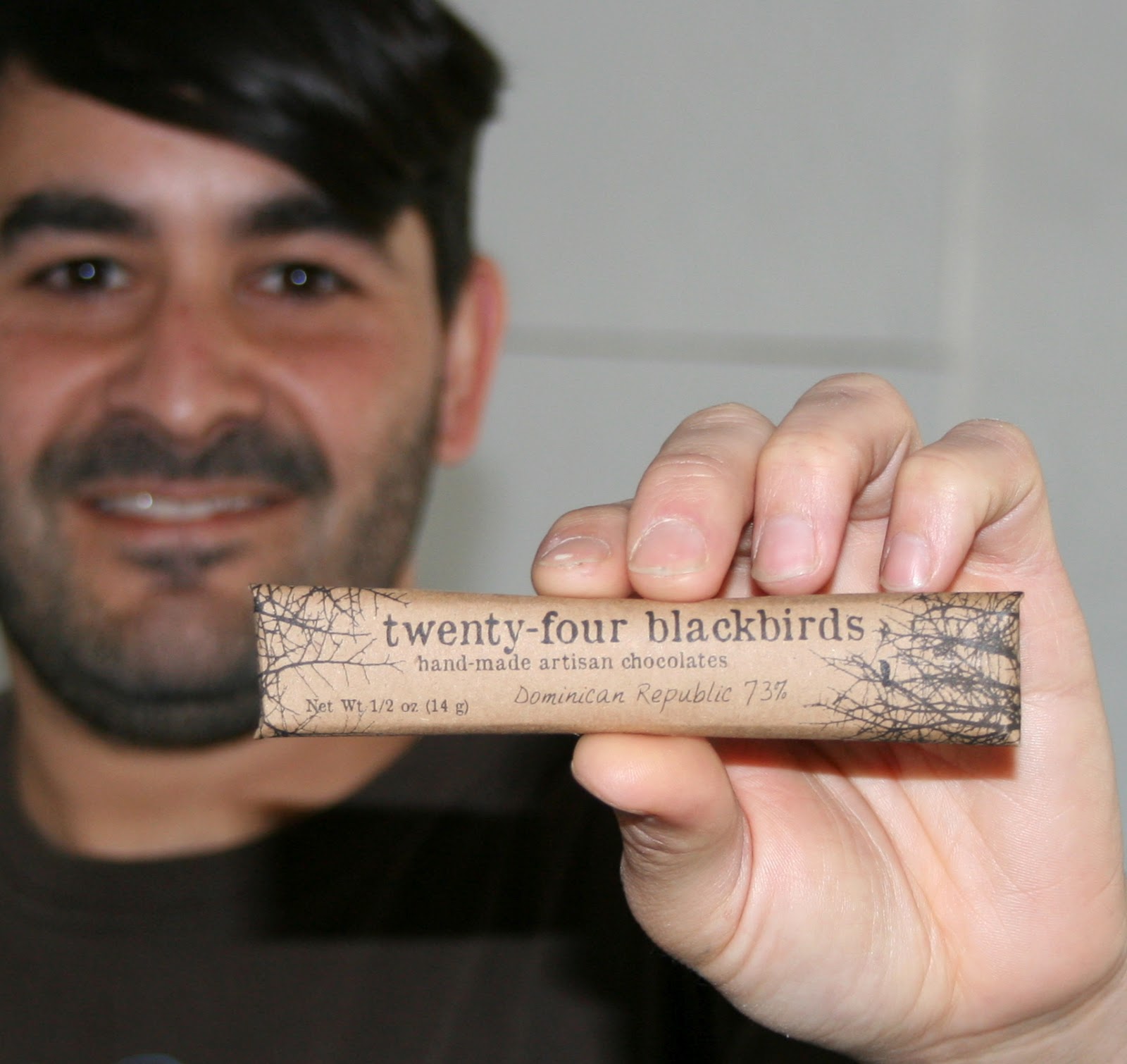
The most recent addition is Twenty-four Blackbirds. What sets them apart is that owner Mike Orlando actually makes his chocolate from raw beans. The others buy bulk chocolate, then change/add ingredients to suit their preferences, but Orlando buys raw beans from places like Peru, Madagascar and the Dominican Republic, roasts them, crushes them, refines them and molds them into bars. It’s a time consuming process but he is one of the few people in the U.S. to make chocolate by hand. A former analytical chemist at UCSB he’s well adapted to the specificity of the tedious process. What you get is cocoa and sugar, that’s it; chocolate bars that are hand signed by lot number and expiration date. And his chocolate is probably the purest expression of original cocoa - deep, bittersweet and fast becoming an obsession around town. Telegraph Brewing Company has partnered with him to make a chocolate beer. His bars sell for $2.50 and you can find them at The French Press, Pierre Lafond in Montecito, and Chocolate Maya.
Mike Orlando Makes Bean-To-Bar Chocolate

For additional cool info about cocoa in Santa Fe, New Mexico, check out my other blog, www.Exploracation.blogspot.com


Sample These Places!

Wednesday, February 22, 2012

Alsace in America: Mendocino Memories


So, what if there were a wine festival which was unpretentious, fun, not the least bit crowded, where international winemakers and their wines congregated together, all set in beautiful surroundings and was, well, just way cool? Well there is. The International Alsace Varietals Festival arrives each February in Mendocino (slightly north of Sonoma), and with it, a die-hard contention of Riesling, Gewürztraminer, Muscat, Pinot Blanc and Pinot Gris enthusiasts. And we’re not talking flabby sweet wines which taste like packets of Equal mixed with water. We’re talking serious non-sweet, semi-sweet and luscious sweet white wines which will literally change your mind about what a white wine can be. There has long been a belief that these kinds of wines are simplistic and that “serious wine drinkers drink red,” but that is nothing more than a short-sighted, myopic view, plagued by insecurity. All wines, white, sweet, red and bubbly, have a place on your table.

Life is not all Chardonnay and Sauvignon Blanc, it can be, but frankly, aromatic white wines should be part of what you are drinking on a regular basis. This is a small conference but it packs a mighty punch. It begins with a technical conference; a kind of wine-geeky gathering of detailed, though interesting, information on these wines with about 100 people. This is followed by a grand tasting, with winemakers on hand to pour and talk about their wines. And this is the inherent beauty of this particular festival; it’s small, accessible and dedicated to, not to a wide variety of wines, but a focused presentation of a select few, which gives you the chance to really hone your understanding of these varieties. The technical conference also presents unique one-of-a-kind opportunities. For 2012, the New Zealand Riesling Challenge allowed attendees to sample 12 different iterations of Riesling, made by 12 different winemakers from New Zealand who each made Riesling from grapes from a single vineyard. Given there were so few cases produced, and the majority of those were kept inside the country, this was a rare and very cool chance to taste how 12 people interpret one wine made from one plot of land.
Fresh made pizza is at the Festival

But Mendocino is not just aromatic whites. Many of the wineries which line Highway 128 are making some killer juice. Foursight Wines, located in Boonville, is a prime example of this. Making Sauvignon Blanc, Semillon and Pinot Noir, their bottle prices range from $20 to $46 and since this is a family-owned operation, one of the family always staffs the small tasting room. They are fourth-generation farmers, producing fewer than 2,000 cases of wine, and the tasting room sits on the site of an old farm house when this land used to be a sheep ranch. Probably an anomaly for the region in terms of aromatic whites, they don’t often produce one. Owner Kristy Charles and her husband Joe Webb started by making wine for themselves at first, just one barrel actually, sharing it with their friends, then slowly expanded to a commercial venture. They are the first tasting room in Boonville and a highly recommended stop. The tasting fee is a mere $5.
Kristy Charles at Foursight Wines
Up the road, just passed the blink-and-you-miss-it town of Philo in what is called the “deep end” of the Anderson Valley (a cooler more fog-laden area) Handley Cellars has been making wine for three decades here. Chardonnay, Riesling and Pinot Noir are their strong suits and with diurnal swings of 50 degrees (the extreme highs and lows of a daily temperature flux) there is a clear acidity in their wines which is crucial for wines which work well with food. I was fortunate enough to taste 10 year-old Rieslings with co-winemaker Kristen Barnhisel, and I mention this because the Rieslings held up stunningly well. They make 12,000 cases a year, using a dedication to a restrained style of wine. These are not big alcohol bombs, but, true to the region, are delicate wines, both whites and reds. I also barrel tasted through several Pinot Noirs. Their bottle prices range from $15 up to $52. Both Handley and Foursight farm their vineyards as certified organic and are definitely worth a visit when you head to the Anderson Valley.
Kristen Barnhisel of Handley Cellars

For additional info on the Mendocino wine region, get a paperback copy, or download an e-book copy of my travel book, “California Wine Country.” Copies are available nationwide, and at: http://www.amazon.com/Moon-California-Wine-Country-Handbooks/dp/1598805959

Fresh shucked oysters are always a hit at the Alsace Festival

Tuesday, December 13, 2011

Cruising Carmel

Carmel
is known for many things – Pebble Beach, great food, expensive homes, and its dog-friendly appeal. The cool thing about Carmel is you can drop your car and not need it for the weekend. The street grid, one square mile by one square mile, has everything you need: lodging, food, shopping, wine tasting, the beach and more. Sure there are a few sights that require a brief drive like Point Lobos, Carmel Mission, and the Monterey Bay Aquarium, but you can come to Carmel and literally not drive for days.

The old world charm of Carmel draws people from across the globe and one of the novelties is that there are not any addresses, seriously. Directions are given as: “on 7th between San Carlos and Delores,” or, “the northwest corner of Ocean Ave.,” but the town is immensely walkable. Known for shopping, there are plenty of clothing stores, a few antique stores and tons of art galleries. The best is the Carmel Art Association; a co-op of 120 talented artists all of whom live within a 30-mile radius. The association was founded in 1927 and you will find oil and pastel paintings, wood and ceramic sculpture and whatever an artist dreams up. Artists bring in new works on the first Wednesday of each month, ensuring a constant rotation. 

Wrath Tasting Room
Wine tasting rooms have exploded in the tiny hamlet and Caraccioli Cellars is located right downtown. Their focus is sparkling wine and they are one of the few to make sparklers in the entire county. Their wines range in price from $20 to $57, and tasting fees start at $5 and head to $15. And Caraccioli is one of the few places open later (Carmel is notorious for rolling up their sidewalks early) so you can sample a sparkler from Pinot Noir of Chardonnay before or even after dinner! Wrath Wines too has a tasting room in Carmel Plaza and pours mainly Pinot Noir and Chardonnay made by the crazy talented Sabrine Rodems. And there are at least half a dozen other tasting venues, so go explore.
The pristine white sand of the Carmel City Beach is dog friendly too. As you stand at the water’s edge to your right is Pebble Beach, to your left is Point Lobos. It’s often best to walk down to the beach as the parking during peak times is congested. However, if you walk, remind yourself that you need to head back uphill all the way to town (Carmel is built on an angle), but it’s a good workout.

The Carmel City Beach
For a fabulous meal, consider Mundaka, a tapas restaurant styled in the Spanish motif in a casual, informal environment, something a little unusual for Carmel’s white table cloth dining venues. Chef Brandon Miller creates a terrific diversity of small plates like the Galleta (fried quail eggs on top of a biscuit and iberico gravy), and Coliflor, which is blanched cauliflower topped with a gratin of pureed cauliflower, horseradish,  gruyere cheese then baked, resulting in deftly prepared crowns, soft but with an al dente crispness to them. But my favorite, much to my surprise, were the Hamburguesa; lamb sliders with a slice of pickled cauliflower, with string-thin French fries. The lamb is delicately counterbalanced with the slightly tart cauliflower, creating an earthy tang. To wrap up the Pan Chocolate is, in essence, a fudge-like bar of chocolate with an immense amount of pure cocoa, topped with sea salt and drizzled with a wee bit of olive oil.

Breakfast at Em Le's
For breakfast consider Em Le’s, the hole-in-the-wall which first opened in 1955 and still provides big breakfasts. The space is small but the large omelets will ensure that you’re full for a long time. It is mainly a locals place and that’s really half the fun. Bistro Beaujolais hints at French overtones including crepes, French onion soup and Croque Madam. Inexpensively priced it’s a fine stop for lunch inside the Carmel Plaza, the only outdoor mall in the city limits.
Hofsas House

End your days at the family-owned Hofsas House, a terrific dog-friendly hotel. I’ve stayed here many times and the 4th floor rooms with Dutch doors are the best with their views across the Cypress trees to the Pacific Ocean. The rooms are large, a few antiques scattered about and it’s comfortable and casual allowing you to relax. They have a year-round heated outdoor pool, a European dry sauna and an informal continental breakfast available in the lobby of coffee, yogurt and pastries. There is wireless access, and it’s an easy four block walk to the town core. They accommodate lots of large gatherings like family reunions and clubs, and have a dedicated building for just this kind of thing. And they have their own parking lot. That might seem like a non-mention, but many hotels in Carmel don’t have one. In fact on my last visit one of the premier properties (with no parking lot) meant that the Lamborghini was parked on the street! Carmel is expensive but Hofsas House is reasonably priced with seasonal rates averaging $150 to $170. 

EAT:

STAY:

DO:


Sunday, November 6, 2011

Say Cheese: The Sonoma/Marin Cheese Trail

I like cheese. Scotch that, I love cheese. I’ve been on wine trails, hiking trails, even a bourbon trail, but nothing is quite as sensual as a cheese trail. Sonoma and West Marin Counties, north of San Francisco, are returning to their roots as dairies and creameries flourish with tours and tastings of artisanal cheeses from cows, sheep and goats with unique flavors and a definite sense of place.
Peta-Where?
The cheese trail is spread out (pun intended) covering nearly 30 dairies and creameries, so the easiest thing for cheese trail ingénues is to drive from Petaluma to Point Reyes which can be easily accomplished in a weekend.

At the Weirauch Dairy
Petaluma, off Highway 101, just west of Sonoma, is home to Weirauch Farm & Creamery who focus on sheep cheese, though they make some cow cheese too. Carleen and Joel Weirauch have a farmstead operation; they make cheese from their own herds. Their farm tours are $15 per person and are for cheese club members (so join up!) and you’ll see the entire cheese-making process, and hang out with the sheep in the pasture. They’re cool people and they love cheese – who else would aspire to make sheep cheese for a living? The tour ends with a cheese tasting of which their Harissa-spiced sheep cheese is amazing. Dedicated to sheep, (Carleen tells me one of their wedding presents was their first two sheep – all I got were crappy placemats and weird-o serving trays) Joel spent a year with cheese makers in France learning the ropes. Available at local farmers markets, if you see Weirauch cheese, get some.

Jana McClelland milks a cow...wow!
For McClelland’s Dairy it’s all about milk, butter, cheese and ice cream…and cows. McClelland’s offers a terrific 1.5 hour tour, and allows you to see firsthand the entire process of running a dairy, complete with sustainable design, as well as sampling their terrific butter, and you get to milk a cow by hand (insert joke here_____). Jana McClelland tells me that milk is 87 percent water (no wonder it looks translucent), whereas her golden-hued butter is 85 percent butter fat, making it rich, creamy with a deep yellow color and a slight nuttiness. A great product and wonderful tour, this is perfect for the kids. McClelland’s is Animal Welfare Certified.
The cool Metro Hotel in Petaluma

While in Petaluma, a surprisingly pretty Victorian town, there are plenty of restaurants, art galleries and antique shops, and the Metro Hotel is a cool place to hang for the night. The building was part of an old estate, formerly the maid’s quarters. The Metro is funky, colorful and off-beat with a decidedly Parisian theme. Rooms have claw foot tubs, hardwood floors, free wireless and it’s within walking distance to downtown. There’s a small continental breakfast every morning which can be enjoyed inside, or on the side garden patio. Or visit Della Fattoria, the best known bakery just up the street with fresh baked breads, scones, croissants, and they use McClelland’s butter in their pastries.

A multitude of cheese at Cowgirl Creamery
Get to the Point
The drive to Point Reyes from Petaluma is less than 30 minutes. Once there Cowgirl Creamery is one of the well-known cheese makers in the region and they are distributed nationwide. Their creamery is the de facto stop for not only sampling Cowgirl cheeses but other locally made cheeses. They also have a cantina on site making sandwiches and salads using their cheese. True to their original vision of supporting local dairies and creameries, you’ll also find organic ice cream from dairies like Strauss. Cowgirl sources their milk (they don’t own cows) from local farmers who produce organic milk, in which to make organic cheese, of which their Red Hawk truly represents a specific sense of place, since it’s only made in Point Reyes due to the large concentration of a specific bacteria in town. There’s a large window to watch the cheese making, frankly a rather dull process since milk is poured into stainless steel vat and it churns away.

Getting Point Reyes cheese ready for shipping
At Point Reyes Farmstead, their tours are something of an event, usually running about four hours, but include an hour long tour of the property, tucked away unseen above Tomales Bay, a visit with the baby calves and ending with a cheese and wine pairing and a chef prepared four course meal utilizing Point Reyes cheese, so you get the farm to table experience. Events begin at $75 but you’ll be immersed in a world you probably didn’t know existed. They are known for their blue cheese, but also make an award winning cheese called Toma, which I adore. The Point Reyes Vineyard Inn is an ideal choice for lodging while there. First off, it’s a house (not a B&B, nor hotel), and you have reign of the kitchen, a TV room and spacious living room. The second reason is that they make wine on the property and the tasting room allows you to sample a variety of wines, including Pinot Noir grown just steps from the rooms. If you stay there, you get a complimentary tasting, otherwise its 5 bucks per person and it’s the only winery in the area.

Street grilled oysters from Tomales Bay
In Point Reyes there’s plenty of hiking, kayaking in Tomales Bay, and visiting the famed lighthouse. It’s quiet here, well, except for the weekends when the small town of 350 more than triples. You’ll find live music and plenty of oysters being grilled outside, harvested from several of the local oyster fisheries in the bay. While on the cheese trail, be warned that tours mean you want comfortable shoes that can get dirty (watch out for them cow patties), you’re on a farm, not a red carpet.

EAT & TOUR
Weirauch Farm & Creamery (http://www.weirauchfarm.com/)
McClelland’s Dairy (http://www.mcclellandsdairy.com/)
Point Reyes Farmstead Cheese Company (http://www.pointreyescheese.com/)
STAY
Point Reyes Vineyard Inn (http://www.ptreyesvineyardinn.com/)

Saturday, October 1, 2011

Chamisal Vineyards: A Day in the Life

You probably have never heard of the Edna Valley. It’s sandwiched between San Luis Obispo and Pismo Beach, and this small inland wine growing region, home to a dozen wineries, is beginning to get its share of attention. The first vineyard planted here was Chamisal Vineyard in 1973. It then became another winery but has now come back (forgive the pun) to its roots. Fintan du Fresne, a New Zealander by birth, is the winemaker here. Chamisal has reclaimed not only its name, but its emphasis on Chardonnay and Pinot Noir. I got to spend a few days with Fintan, Fin as he’s called, during the 2011 harvest.

Fin explains calcareous soils
Before we get to grapes, a word about Fin’s hair. In these photos it’s a mohawk. Every year during harvest Fin cuts his hair; not only a change of appearance, but a sign of the forthcoming harvest. It made me think about doing some yearly thing as a writer…I don’t know, maybe a slice of pie each time I meet a deadline (I simply can’t pull off a mohawk like Fin).

Chamisal makes 50,000 cases a year of wine, predominately Chardonnay and Pinot Noir, but there is also Syrah, Grenache, Pinot Gris and a very intriguing stainless steel tank Pinot Noir (virtually all Pinots are barrel fermented or barrel aged). Though Fin has a preference for indigenous yeasts (those yeasts which live naturally in the vineyard) he uses some cultured yeasts – those grown specifically for the purpose of making wine. “With cultured yeasts I can still direct the flavor profile,” he says, meaning he doesn’t have to rely on wild yeasts that may do something unexpected during fermentation. He produces three Chardonnay’s (ranging in price from $18 to $38) and three Pinot Noirs ($38 - $80). I’m a fan of the lesser expensive Chard and Pinot, not because of the price, but because the Chard is stainless steel fermented making it light and crisp with terrific acids, but used to match with food.

The Pinot is a blend of 9 different clones and has traditional soft raspberry notes. The other Chards and Pinots use more oak, not a bad thing; I just prefer a lighter style of wine, but check out their entire portfolio and find what your like. They offer 2 different tastings of wine priced at $9 and $15, and many of their wines are tasting room only, so you won’t see them on store shelves. They have a lovely outdoor picnic area where you can get a bottle of wine and share it with your friends (call me I’ll be right over!). Chamisal is SIP certified, (Sustainability in Practice) a Central Coast-based sustainable farming certification process, which is more rigorous than many sustainable programs on the state and federal level, and takes into account whole farm integration of its resources. To that end the wines are made in concert with the environment. After all, it’s important to have respect for our earth with our farming practices. But harvest is not all work.

Just pressed Pinot Noir grapes at Chamisal
We kayaked at Morro Bay with a crew from Central Coast Outdoors, who provide a great selection of adventure trips, and paddled the back bay observing shore birds, seals, sea lions, and making a brief appearance - an otter.

At one point a seagull hopped aboard Fin’s kayak, looking for food, but the bird decided to just hang out and, apparently being a free-loader, stood on Fin’s bow for about 10 minutes. Back at the winery we tasted through tank and barrel samples of wines he’s currently working on.

Fin and the free-loader seagull
Specific to this, he lets me taste Pinot Noir clone 667, picked and crushed the day before. The bright pink juice is sweet (as wine grapes are) and still has scents of the dirt and the vineyard. Another tank sample, in the thick of the fermentation process and also clone 667, was picked and crushed a week prior. There is little tannic structure and the fermentation causes a nearly astringent mouth feel but it is a more mature example of the first tank sample, a simple grape-juicy beverage. Eventually these Pinots will be blended into either their estate wine, or maybe their Monologue, a high-end Pinot Noir made only in certain years when the exact conditions are right to create an outstanding wine.

Barrel samples of Pinot Noir

Chamisal Vineyards is, like many of the wineries along the Central Coast, an operation making terrific wines from the calcareous soils in the region and taking advantage of our particular growing seasons. And this is what life is like on the Central Coast, it is work mixed with play, a sense of urgency counterbalanced with a sense of the long view. So stop by Chamisal in the Edna Valley, or any Central Coast Winery and you will be engaged by these juxtapositions. Enjoy, educate yourself and experience what the Central Coast has to offer.
Working at Chamisal Vineyards


Chamisal Vineyard: www.ChamisalVineyards.com
SIP:
Central Coast Outdoors: http://www.centralcoastoutdoors.com/