Sunday, May 15, 2011

The Spirits of Ventura: Tequila, Beer, and Lemons, Oh My!


No, this isn’t a ghost story, unless beer and tequila frightens you. This is liquid satisfaction in downtown Ventura. Located 60 miles north of Los Angeles, Ventura has long been like that middle child in every family – ignored and left behind in favor of the flamboyant kid, namely Santa Barbara. But Ventura is rapidly changing; there is a laid back vibe, easy beach access, strong arts community, and the culinary scene is taking off. But what’s really getting attention is our friend, alcohol.

Anacapa Brewing Company
Wine is booming with nearly 15 wineries from Oxnard to Ojai. But wine gets the lion’s share of attention already, so it’s time to uncover other sweet juices of joy. Micro-breweries are ubiquitous along the Central Coast, but currently in downtown Ventura there is only one: Anacapa Brewing Company. Housed in a 130 year-old building, the narrow interior is bookended by exposed brick walls. Owner Danny Saldana offers five brews on tap, and new brews coming on line all the time. You can only buy them here, or bring in your growler for a fill-up. Their hops come from Yakima, Washington, and their malts from Canada. The result is finely balanced beers; everything from porters and hoppy double IPAs to lighter lagers. They also have a large food menu and are located right on Main Street. (http://www.anacapabrewing.com/) 

Dr. Adolfo Murillo


Mules haul out the agave
What does a local optometrist do when his family ranch in Mexico is up for grabs? Since the ranch was located in Jalisco, Mexico, Dr. Adolfo Murillo planted blue agave in order to produce tequila. All tequila must come from the state of Jalisco otherwise it ain’t recognized as tequila. His organic approach to the barren and difficult ranch land has resulted in better quality agave, stronger, and healthier. Adolfo has shared his organic protocol with other farmers in Mexico, regardless of the crop, and currently there are farmers growing organic in multiple states. You can find his Tequila Alquimia in restaurants and bars in Ventura. His is one of only three or four of the 1,150 different labels of tequila in the world to be certified organic by the USDA. There is the blanco, reposada, añejo, and Extra Añejo, aged six years. These are smooth tequilas, beautifully made and they make excellent margaritas. Adolfo’s recipe defies the conventional approach: One part tequila (he prefers the blanco over an aged version), one part fresh lime juice, ½ part orange juice, and ½ part agave nectar. That’s it, no need for triple sec or Grand Marnier. And the result is a fresh, crisp flavor with the fruit and tequila being balanced. Or have them at room temperature, as these are sipping tequila’s, not shooters. Does organic really matter in a tequila? Well, consider this: the average growing cycle of blue agave is 7-10 years; that’s nearly a decade an agave plant can soak up chemicals, toxins and pesticides. With Tequila Alquimia, there are no chemicals in the ground to begin with. So there. (http://www.tequilaalquimia.com/)

James Carling
Ventura is also home to vast citrus orchards, specifically lemons. So if you’re of Italian descent limoncello is customary back home along the Amalfi Coast. If you’re the husband/wife team James Carling and Manuela Zaretti-Carling, you bring Italy to California. They had been making their limoncello at home for 10 years and were eventually persuaded to move into commercial production. Ventura Limoncello has scored tremendous medals and awards at spirits competitions, even beating itself in one competition. So what is limoncello? Just the best damn lemon liqueur you’ll ever taste. Lemon peel, neutral spirits, sugar and water. There ya go. But the simplicity of ingredients should not belie the quality. James doesn’t use vodka as he believes that vodkas give the liqueur a harsher taste. Only the top layer of the lemon skin is peeled, all by hand, then it’s infused in large glass jars (metal containers leave an aftertaste) with the neutral spirits. In addition to their original version, they produce a crema, one made with milk, and an orange-cello made with blood oranges. Smooth, viscous and addictive, you need to find this when you’re in the area at local restaurants and bars, and take a bottle home with you. Leave it in the freezer and pour it directly into your glass. (www.VenturaLimoncello.com) 
Lemon rinds in neutral spirits, relaxing.

All these diverse liquid refreshments can be found by simply walking Main Street in downtown Ventura, and these family-owned businesses deserve your attention, not just because they offer a local flavor to your visit, but because these are excellent beverages. For more information about Ventura/Ojai including the wines and restaurants, shopping and outdoor activities, check out my Moon travel book, Santa Barbara & The Central Coast. Salud!


Sunday, May 1, 2011

Flowers, Fauna & Fun: Lotusland - A Day in Montecito

Lotusland is 37 acres of the best manicured and lovingly tended to gardens you will probably ever see. Last privately owned by Madame Ganna Walska, a Polish opera singer in the 1920s, she routinely arranged her vast collection of plants into bold color schemes and unusual shapes. For over four decades she tinkered with her gardens, shaping, creating and recreating them to suit her wishes. But the estate was made for this. The first owner had a commercial nursery on the land in the 1880s. After Walska’s death in 1984 her estate, Lotusland, so named because of the lotus flowers on the property, became a non-profit. It is one thing to visit a botanical garden, but it is another to wander through a magnificent wonderland of plants, trees and gardens.

From the moonscape barrenness of the cactus gardens, to the topiary garden and their array of animals, to the serenity of the Japanese garden, to the olive allee and formal English-styled gardens, and across the great lawn, Lotusland is that rare stop where you feel you could stay forever. In fact, one of the staff gardeners has been there for over 30 years. It is truly an awe-inspiring place. It can get brisk as many parts are so heavily wooded that you can’t see the sun. The wide walking paths easily accommodate wheelchairs and there is no elevation gain. If you love botany, horticulture, or like me you don’t know much about either but you love plants, Lotusland is a treat. Bring your camera and comfortable shoes.

This is a public garden operating in a residential neighborhood, therefore reservations are mandatory. Lotusland is located at 695 Ashley Road in Montecito, 805/969-9990, http://www.lotusland.org/. Tours are offered at 10 a.m. and 1:30 p.m. Wednesday through Saturday between mid-February and mid-November only. Admission is $25, adults; $10 children age 5 to 18 and the tours last two hours.

If you do the 10 a.m. tour, when you’re done it will be lunch time. Close by in Montecito, a five minute drive away, is what is known as the Upper Village, less crowded than Coast Village Road in the lower village and there are several eateries close by. For sandwiches and salads, sweets and such, the Pierre Lafond Montecito Market, (516 San Ysidro Rd., Montecito, 805/565-1504, open daily from 6:30 a.m. to 8 p.m.) gives you great options to eat there, or take away. The Prosciutto and Basil Flatbread is wonderful, and their Farm Cake is terrific. They also have a coffee bar, small produce area as well as cookbooks, olive oils, chocolates and even a few wines. Or head down to trendy Coast Village Road, where there is plenty of shopping and restaurants, and try the excellent (though pricy) turkey meatballs at Trattoria Mollie (1250 Coast Village Rd., Montecito, 805/565-9381, open for lunch and dinner, closed Mondays), made uber-famous when a local resident by the name of Oprah Winfrey, plastered the meatball recipe on her TV show. From there it’s a two minute drive to Butterfly Beach for a walk on the dog friendly sand.

As it’s probably nearing later afternoon, the Four Seasons Biltmore is right there for a glass of local wine, so you can sip while you stare out to the Channel Islands and watch the sun languidly sink into the Pacific. Not a bad way to spend the day.

Tuesday, April 12, 2011

Coastal Quakes: The Reality & What You Need to Know

Having lived in California all my life I’ve been through many quakes and while you’re never sure how severe one will be, panicking is a bad idea. With the recent tragedy in Japan, it makes sense to explain the major earthquakes on the Central Coast and, at the end of this post, provide practical advice should a temblor occur. Earthquakes are part of the reality in California, but be ready to respond should one hit.

Mission LaPurisima
Lompoc -1812, about 10 a.m. (7.1) No Deaths. This quake destroyed Mission La Purisima located originally near downtown Lompoc. They rebuilt it and moved the Mission several miles away.

Lompoc -1927, 5.49 a.m. (7.1) No Deaths: This earthquake, located about 10 miles offshore produced a sea-quake so violent it killed and stunned fish near Point Arguello and shook two ships in the area. No serious damage.

Downtown Paso Robles

Paso Robles - 2003, 11:15 a.m. (6.5), Two Deaths. On December 22nd, 25 miles North-West of Paso Robles, actually near San Simeon, the earth shook. The damage was centered in downtown Paso Robles and caused two deaths when the roof slid off the clock tower building. The dormant underground sulfur springs ripped open causing flooding and a large sinkhole in the parking lot of the city hall, not to mention the town reeked of the smell of sulfur for months. Paso Robles dedicated a new clock tower in memory of the two women who died. 

Santa Barbara - 1925, (6.8) 13 Deaths. At 6:44 a.m. on June 29th all was fine and quiet on the streets of Santa Barbara. Less that two minutes later a thirty square block of the downtown core had been severely damaged. The Sheffield Dam failed plunging water into the city center; a two acre parcel west of the city sunk nearly a foot; the waterfront road (now Cabrillo Blvd.) sustained cracks of 12 inches. The quake had been felt in Anaheim 130 miles south. Much of the sub-standard construction failed and parts of commercial buildings on lower State St., built on landfill, collapsed. Brick buildings and wood construction shattered. The earthquake not only gave the city a chance to reinvent itself, but forced stricter building codes.

State Street

Architect Julia Morgan (Hearst Castle, Asilomar) was in Santa Barbara that morning. She had arrived, blueprints in hand, to meet with the building committee regarding a potential project. As she waited for the streetcar the earthquake struck and she witnessed clouds of dust envelop State Street. She spent much of that morning viewing the damage, noting which buildings survived and taking copious notes. The city faced destruction totaling $8 million, a staggering sum by 1920s standards.
Had the quake struck later in the morning as people were on their way to work the death toll would have been higher. Unlike the 1906 San Francisco quake, Santa Barbara didn’t have fires to contend with therefore damage was mitigated.

The Santa Barbara Mission
What You Need to Know:
If you are Inside: Take cover by getting under a sturdy piece of furniture and wait until the shaking stops. If there isn’t a table or desk near you, cover your face and head with your arms and crouch in an inside corner where the building supports are the greatest. Freestanding walls fall easily. Stay away from glass, windows, anything that could fall, such as lighting fixtures. Use a doorway for shelter only if it’s in close proximity, and if you know it’s a load bearing doorway. Stay inside until the shaking stops. Research shows that most injuries occur when people inside buildings attempt to move to a different location. Be aware that the electricity may go out or the sprinkler systems or fire alarms may turn on, or that a gas pipe might have broken. Never use the elevators!

If you are Outside: Stay there and move away from buildings, streetlights, and utility wires and wait until the shaking stops. The greatest danger exists directly outside of buildings. Many of the 120 fatalities from the 1933 Long Beach earthquake occurred when people ran outside only to be killed by falling debris from collapsing walls. Ground movement during an earthquake is seldom the direct cause of death or injury.

If you’re Driving: Stop as quickly as safety permits and stay in the vehicle. Avoid stopping near or under buildings, trees, overpasses, and utility wires. Proceed cautiously once the earthquake has stopped. Avoid roads, bridges, or ramps that might have been damaged.

Sunday, March 27, 2011

Sands of Time: The Dunites of the Guadalupe Dunes

The solitude of the Dunes

It requires a stunning degree of short-sightedness to build anything on shifting sands. But that is exactly what was attempted on the Guadalupe-Nipomo Dunes which spans both Santa Barbara and San Luis Obispo county lines, at the turn of the last century. The area was to be ‘the future Atlantic City of the Pacific’ with a boardwalk, a hotel and a pavilion, and venture capitalists were enthralled with the possibility of resort style living on the sand dunes facing the Pacific Ocean. But the wind blown sand wouldn’t stay put and it inevitably won. By 1917, the few foolishly grandiose and now abandoned buildings that had telegraphed a possible new existence had became used lumber which ended up being scavenged by the dune-dwellers, an eclectic group of nomads and misfits who built their own new lives in the dunes.

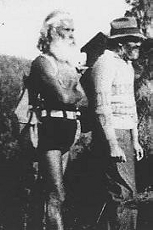
George Blais (L) at the Dunes
The dunes had long been the home of a drifting population of vagrants and eccentrics, but it was in the 1920s that the people who became known as The Dunites claimed the transitory area for their own; a rag tag collection of everyone who felt disenfranchised with the world. Edward St Claire a Spanish-American war veteran turned poet was one of the first to claim residence. Then came George Blais, a reformed alcoholic turned evangelist and a naturist, who dressed to go into town in a loincloth and bandana, but otherwise lived naked in the dunes, surviving off fruits and nuts. One of the most illustrious and flamboyant Dunites was astrologer, writer and socialite Gavin Arthur, grandson of United States President Chester A. Arthur and who ‘had it all’ by the standards of the day, but opted out of society. Probably the most well-known resident of the make shift dune neighborhood was the artist Elwood Decker.

The Dunites even published their own magazine which was distributed nationally called the “Dune Forum,” with contributions by photographers such as Ansel Adams. The magazine was heavy on intellectual style and expensive for the time at 35 cents. The publication ran for five issues before it too succumbed to forces greater than itself. Eventually the Dunites left their Bohemian ways, as life in the dunes simply could not be controlled and to this day, the sands shift where they will. Today a visit to the dunes is still something of an ethereal experience; it’s still relatively isolated, but the stark beauty is worth the drive. But pack a sweater, the winds can be fierce. The official visitors center is located in the town of Guadalupe and provides maps, historical information as well as schedules of ranger led hikes and photography.http://www.dunescenter.org/
The fierce winds at the Dunes create windswept trees like this


Thursday, March 17, 2011

James Dean: Death on the Highway


In the 1950s, James Dean was fast becoming a well-known movie star. He loved making movies, and he also loved fast cars, specifically a silver Porsche Spyder 550 he named “Little Bastard.” In the early afternoon of September 30, 1955, Dean and Porsche factory mechanic Rolf Weutherich were on their way to an auto rally in Salinas, California. Dean was pulled over for speeding in Bakersfield, issued a citation for driving 65 in a 55 zone and released. Dean and his companion continued on their way towards Paso Robles with plans to spend the night, and then head to Salinas the next morning.
Dean and "Little Bastard."
As Little Bastard climbed down toward the little town of Cholame around dusk, Donald Turnupseed, a 23-year old Cal Poly student was heading the opposite direction in his 1950 Ford Tutor. He began a left turn at the intersection of Highway 41 and what was then called State Route 466 (later named Route 46), unaware of the Spyder approaching. The two vehicles met nearly head-on. Little Bastard crumpled and spun around, throwing Weutherich out of the vehicle. The car came to rest about 15 feet off the road near a telephone pole. Weutherich suffered a broken leg and serious head injuries, though he survived. Turnupseed escaped with a bruised nose and gashed forehead. However Dean suffered fatal injuries. The Coroner listed the cause of Dean’s death as a broken neck, multiple fractures of the upper and lower jaw, fractures to the left and right arms and severe internal injuries.

Contrary to news reports of the day, Dean’s car was not going in excess of  80 MPH. California Highway Patrol Officer Ron Nelson, one of the first to arrive on the scene, wrote in his report that the wreckage and position of Dean’s body, “indicated his speed at the time of the accident was more like 55 MPH.” Nevertheless, people speculated Dean was speeding and that he was still alive shortly after the accident. Regardless, he was pronounced dead at a Paso Robles hospital. He was 24.
CHP officers Ron Nelson (L) and Ron Tripke (R)
In 1977, a James Dean memorial was erected near the site of the crash. The stylized sculpture is composed of concrete and stainless steel around a tree located next to the Jack Ranch Café in Cholame. The café is still there as is the memorial, but that’s all that’s left of the little town. Japanese artist Seita Ohnishi built the memorial in Japan and transported it to the U.S., never clearly revealing why he had done this. At the dedication Ohnishi stated, “I am only one of many who feel strongly that James Dean should not be forgotten. There are some things, like the hatred that accompanies war, that are best forgotten. There are others, like the love inspired by this young actor that should be preserved for all time.”

The memorial is not the exact spot where the crash occurred; that spot is approximately 900 feet to the northeast, before the highways were realigned. In September 2005 the intersections of highways 41 and 46 were renamed the James Dean Memorial Highway. Donald Turnupseed went on with his life, forming a fairly successful electrical contracting business and avoiding the spotlight. He refused all interviews and passed away in 1995, never talking about the crash. The site still draws visitors and curiosity seekers. James Dean made only three films: Rebel Without a Cause, East of Eden, and Giant, but his legacy lives on.