Monday, April 23, 2012

Breakfast + Lunch = ....


The dessert station at the Bacara

Brunch. It’s what’s for dinner, or technically it’s what is between when you wake up and dinner. There are all manner of brunches in Santa Barbara from the Four Seasons Biltmore in Montecito (traditional station brunch on Sunday, $72 and $35 for kids; Saturday À la carte brunch $15 to $28), to scaled back versions like the Canary Hotel near mid State Street (brunch is Saturday and Sunday from 7 a.m. to 2:30 p.m., À la carte, $10 - $20) and Stella Mares (Sunday brunch À la carte menu, $12 to $23) located at the Andree Clark Bird Refugee. But for those days like Mother’s Day (the mother of all brunch days) you want to pull out the stops. The brunch at the Bacara Resort and Spa will fit that bill, and fill you up, all overlooking the Pacific Ocean. Located inside the terrific restaurant Miro, the Sunday Brunch is a blowout.

The organic salads are made to order
But where did the idea of a half-breakfast, half-lunch idea originate? We do know that “brunch” was first mentioned in 1895 in a British magazine called Punch. More than likely it was a term used for post-drunk reveler food on Sunday morning after a blitzy Saturday night of hard drinking. Allegedly it was a slang term but it doesn’t mean that the first iteration of brunch was just a way to pack protein into your body to offset too much alcohol. But it certainly seems likely. There is no clear information as to the exact origins, only conjecture. Regardless, the idea of brunch has been with us for over a hundred years now and certainly the elements of brunch have become more refined. And these days brunch is something of a ritual: Easter, Mother’s Day, Christmas and even New Years are prime brunch days, or like many people, you have a brunch party at your house (as I have done for years). Brunches consist of two different experiences: a traditional sit down restaurant where you order off the menu; and the station brunch where there will be stations around the restaurant for dessert, a carving station, another for made to order eggs and omelets, and the like, and you can eat as much as you want (please don’t make the mistake however of thinking you need to eat everything – I promise, you won’t feel well later).

Plenty of seafood, well, plenty of everything!
With a focus on local, seasonal produce, the Bacara brunch showcases a culinary happy-land highlighting organic produce from local farms at their salad station. And there are made-to-order omelets and waffles, seafood displays of oysters, crab and huge shrimp, and sushi. And like with the best brunches, there is prime rib from their carving station, artisanal cheeses (I’m loving the Humboldt Fog), plenty of side potato-based dishes, fresh fruit and an entire bagel bar. All this and way more is set inside the spacious and colorful Miro environment. Oh, and you can have mimosas or Champagne.

The dessert station includes chocolate-covered lollipops with pistachio cheesecake inside, to chocolate and strawberry mousse, carrot cakes, whoopee pies, and pots de crème, all created from scratch by pastry chef Daniel Sampson, who learned some of the basics from him mother, grandmother and aunt growing up in Nova Scotia. Personally I love his meringue with fresh whipped cream, passion fruit, strawberry and kiwi. There are over 25 different desert items to sample. Brunch is $70 for adults, and $30 for the young ones and has more food than mentioned here, a virtual food bonanza with something to make everyone satisfied. It’s best to make reservations at all of these brunch spots, then enjoy and be happy that you are brunching here in Santa Barbara


Monday, April 2, 2012

Catastrophic Failure: Ventura County & The St. Francis Dam Collapse


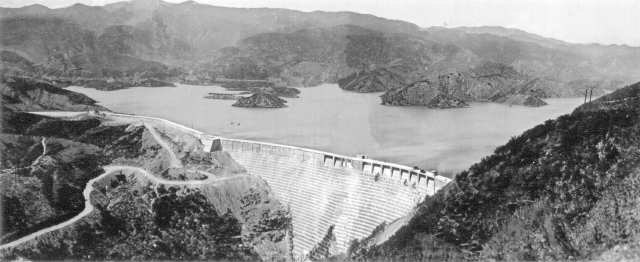
The St. Francis Dam shortly after completion

At five minutes to midnight, on Thursday, March 12th, 1928, the towns of Santa Paula, Newhall, Piru and Fillmore in Ventura County, spread out along a river valley, were undoubtedly peaceful, sequestered from harm, residents asleep in their warm beds. Less than three minutes later, all hell would break loose and 600 people would be dead. The event was the single worst engineering disaster of the 20th Century in the United States, and the second worst disaster in California history. Though it has become a footnote in Ventura’s history, the St. Francis Dam Disaster is a tragedy of unparalleled proportions. Why the dam was built and why it failed is a complex story of greed, vision, money, and dreams of the future. Fundamentally however, it’s about an essential human resource - water.

Desert
The dry riverbed of the St. Francis today
Southern California is a semi-arid environment. Water, we assume, has always been plentiful. Everyday we observe people washing their cars, shopkeepers hosing down concrete sidewalks; we see lush lawns and gardens, and it streams effortlessly from our faucet as we brush our teeth. But water comes at a price, even the price of death. When Los Angeles began to grow exponentially, William Mullholland, the chief engineer of the Bureau of Water Works and Supply, the precursor to the Department of Water and Power (DWP), envisioned Los Angeles as a utopia for millions of people, who dwelt on the banks of the Pacific Ocean as carefree sojourners, however Los Angeles would soon run out of the one thing that made its existence possible - water. The Owens Valley was a rural farming community, 250 miles north of L.A. and it held massive amounts of water, fresh from the snow packs of the Sierra Nevada’s, which could provide the burgeoning metropolis with every drop it needed.
 
Deception
Los Angeles began to surreptitiously buy water and land rights in the Owens Valley. But getting the water to Southern California was a problem. In 1910 Mulholland built an aqueduct 230 miles long, using gravity flow over mountains and across deserts, which is still recognized as one of the great engineering achievements of the early 20th Century. As water levels in the Owens Valley decreased, anger increased. Mulholland’s aqueduct was repeatedly dynamited ten times. But Los Angeles continued to grow faster than anyone anticipated. When the Owens Valley ran dry, L.A secured water from Mono Lake, north of Owens Valley; then the Colorado River in Nevada; then the Feather River near Sacramento. That Los Angles was unable to secure a dam site in the Owens Valley, known as Long Valley, in order to build a vast reservoir, proved a terrible and costly oversight. Mulholland believed that a series of dams and reservoirs, closer to L.A., away from the politically unstable Owens Valley, would be the safe bet in case emergency water was needed. He decided on a narrow canyon, north of Santa Clarita, known as San Fransicquito Canyon.

The day after the collapse - notice the two persons in the lower right
Construction
Construction of the St. Francis Dam began in April, 1924. In July of that year, the original dam height of 184 feet was extended 10 vertical feet in order to expand its holding capacity. One year later another ten vertical feet was added. Raising the dam 20 feet allowed more storage capacity, but what was overlooked was widening its base to be commensurate with its new height. Known as “hydraulic uplift,” the base of the dam actually raised up slightly prior to its demise due to its inherent instability. It short, it became top-heavy. Additionally, the rock the dam was anchored to, known as schist, a flaky metamorphic rock, was not fully understood by the engineers at the time, nor did they know that the mountain the dam was adhered to was part of an ancient landslide and was also inherently unstable. Simply put, the technology did not exist to know unequivocally that the rock was solid.  It wasn’t. The dubious rock was becoming saturated with water. Ironically, on March 11th, the day before the failure, William Mullholland himself inspected the dam about 10:30 a.m. and pronounced it secure.

A colored rendition of the dam showing only the center section
Failure
At 11:57 p.m., the St. Francis Dam collapsed. The left side of the dam gave way first, unable to support the weight of nearly 13 billion gallons of water. What was once a life-giving force turned into death itself and merged with the Santa Clara River. The initial wall of water was 200 feet high. Of the 70 people that lived just below the dam, only three survived. By the time the water hit Castaic Junction, near present day Magic Mountain, it was 75 feet high and Santa Paula faced a torrent still 25 feet high with trees and broken houses acting like battering rams obliterating everything. The path of destruction was 54 miles long. In Newhall, a makeshift morgue was set up in the dance hall, which was still festooned with decorations from the dance held there the night before. “Bodies found by the river were so heavily encrusted with mud they had to be hosed off when they got to the mortuary to see if they were breathing,” recalled survivor Elizabeth Blanchard. Five and a half hours after the dam collapsed it lapped the Pacific Ocean near Ventura Harbor. If you drive highway 126 today, it’s possible to retrace the nearly exact route the water took through the Santa Clara River.

Mulholland (L) inspects the dam the day after the collapse
The “official” death toll was 450 people. Many historians believe that with the number of migrant Mexican farm workers living at Camulos, the death toll was closer to 600. “There were a lot of Hispanics living by the river and a lot got killed,” recalled survivor Eva Griffiths of Santa Paula. “The police tried to warn them, but they didn’t understand English. It was terrible,” she said. Poor immigrant workers don’t land on the front page of major newspapers, not in 1928 and certainly not today. But they died. By the hundreds.  Cattle too; livestock, cars, roads, power lines, bridges, rail track, farms, all washed to the ocean or covered in a blanket of mud, debris and wreckage nearly 30 feet thick. Bodies were recovered as far south as San Diego. Some bodies were found weeks later in the isolated canyons along the Santa Clara River. And some bodies have never been found.  Men, women and children were obliterated in the middle of the night, in their beds.  Some fought the torrent of water, only to drown or be crushed by the fast moving debris.  Perhaps mercifully so, some families died instantaneously, family pets being the only survivors; mute witnesses to the unthinkable. 

The numbers are staggering: 1,200 homes demolished, 24,000 acres of fertile land destroyed, almost 11,000 acres of crops laid waste, 140,000 trees uprooted or badly damaged. Nearly 3,000 volunteers searched for bodies. The reality is that the St. Francis Dam should never have been built where it was. Had Los Angeles secured the necessary property rights for the Long Valley reservoir, the St. Francis would not have been constructed. But politics and myopic thinking prevented a logical solution. The fact remains that the St. Francis Dam killed scores of people, bankrupt farmers in the Owens Valley, and brought riches to Los Angeles. If history means anything, L.A’s success was purchased on the backs of dead and dying people.

Just some of the hundreds of bodies recovered
Aftermath
After multiple inquires and reports, dam safety legislation changed. Prior to the St. Francis, there was little dam construction oversight. Two days after the St. Francis fell, the federal government required all dams to be inspected (similar to the widespread concern of bridges after the I-35 Mississippi River Bridge collapsed in Minnesota killing 13 people). California mandated professional registration for engineers, and the DWP established soil compaction tests and acquired a greater understanding of hydraulic uplift.

There were a multitude of design deficiencies of the St. Francis. It’s now understood that the dam was built into an ancient landslide, something Mulholland could not have known at the time, and in fact 254 dams worldwide have been identified as having been built against such unstable rock, though currently they are still standing. But probably the greatest single factor was the decision to heighten the dam a second time. The resulting hydrostatic pressure on the dam and its left abutment created an untenable situation. In fact, around 8 p.m., four hours before the failure, on a road that ran above the dam, one witness recalled seeing a 12-inch high mound of dirt across the roadway. The landslide had actually begun hours before the collapse.
Looking downstream today with the remnants of the dam in the foreground

Today the dam site is tangible history. There are discarded beer cans, soda bottles and spent shell casings lining the old flood path, a disturbing reminder that tragedy means nothing if it is forgotten, and that respect for the loss of life is little more than a trash heap. Parts of the dam are still visible, though malformed and eroding. What is eerily noticeable is the landslide, clearly cut from the mountain even over 80 years later. There are few remaining survivors to the tragedy but in 2007, writing an article for the Ventura County Reporter on this subject, I sat down with Catherine Mulholland, granddaughter of William Mulholland - who passed away in July, 2011. “By now we know that Homo sapiens have plundered the earth,” she told me. “We’ve dislodged, displaced and removed forests and oceans. We’ve flourished and also suffered. When you move water, things get destroyed in the process.”
Catherine Mulholland during my four hour interview with her - 2007

Thursday, March 15, 2012

Courting Beauty: The Santa Barbara County Courthouse


The Santa Barbara County Courthouse has been rightly called the most beautiful public building in America, and honestly there is no argument. You don’t have to know anything about architecture to be in awe of this impressive building so make sure you bring your camera. This is classic Santa Barbara and you need to see it when you visit. Covering an entire block the courthouse is a stunning example of Spanish and Moorish (Persian) design. William Mooser III designed this courthouse to replace the earlier 1872 version built on the same site, a Colonial-Jeffersonian looking thing with a massive domed copula and lots of columns.
The Sunken Gardens from the Clocktower

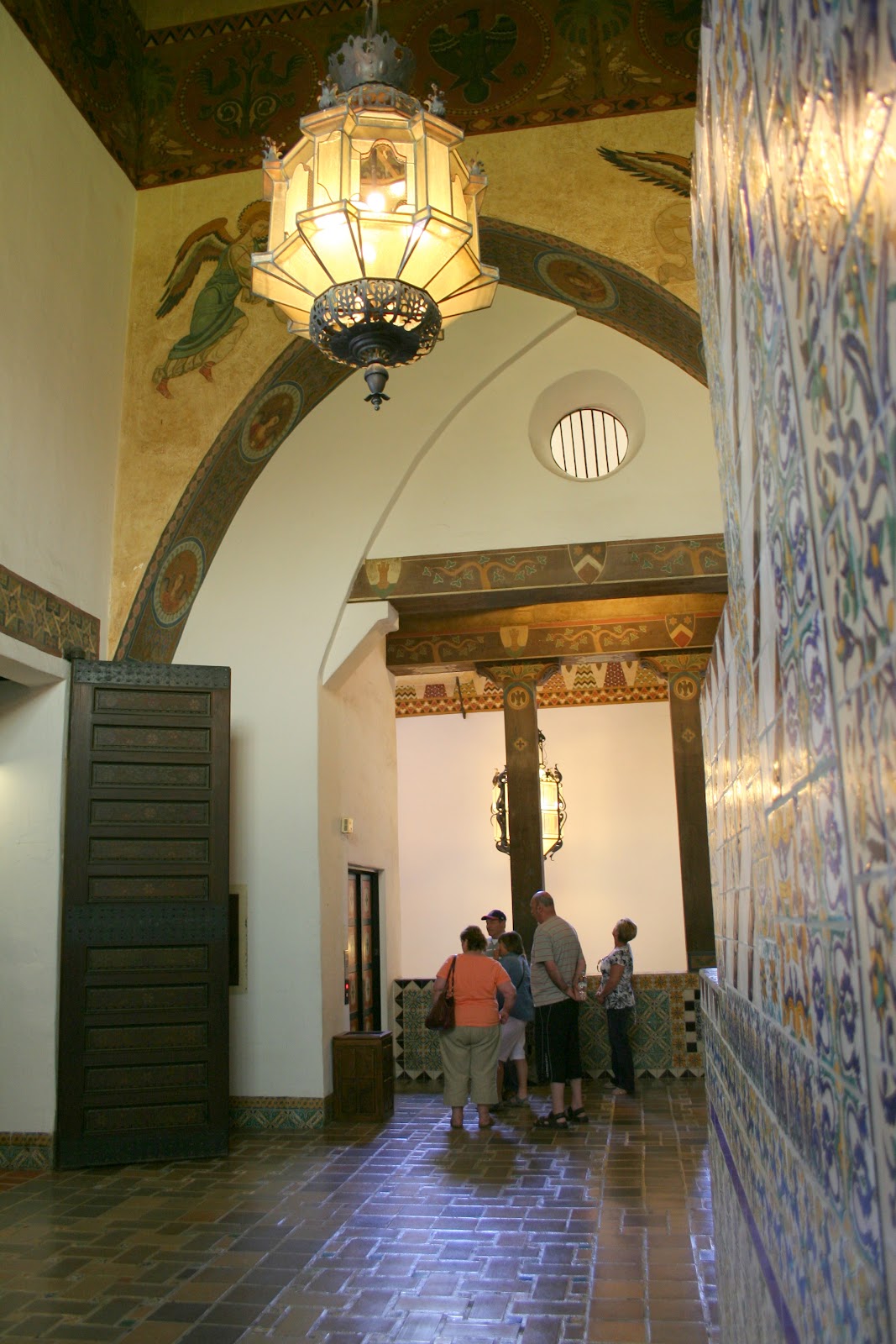
But the 1926 earthquake changed the face of Santa Barbara forever. When the new courthouse was completed in 1929 it was unlike anything in the city. Lush grounds including the copious lawn and Sunken Gardens (you’ll find lots of concerts and events happening here) lay the foundation for the sandstone building with arabesque windows, archways, hand painted wood ceilings, and walls with intricate designs, and pueblo tile inlays nearly everywhere flashing brilliant colors and native designs. While you visit make sure you look up - the hand painted ceilings and beams were done in a style known as Dutch-Metal whereby paint was mixed with copper and zinc to achieve what looks like gold inlay.
Of particular note is the Mural Room, once used for the county board of supervisors for about 30 years. The huge room (40 feet wide by 70 feet long with 25 foot ceilings) is covered in a mural depicting the early Chumash Indians and following the history of the area towards California statehood in 1850. (As a matter of worthless trivia, the City of Santa Barbara is actually older than the State of California: Santa Barbara was founded on April 9th, 1850, and California achieved statehood on September 9th, 1850, so there!) The chandeliers in the Mural Room weight in at half a ton each.

The Clocktower, known as El Mirador, is one of the tallest structures in the city, a mere 85 feet, but it is here where you will get the best views of downtown, the mountains and ocean from a downtown perspective. Take the elevator to the fourth floor. Once there, a dozen steps lead up and out to the platform. You’ll be thrilled at the red tile roofs splayed out in front of you on the nearby buildings, the Rivera where you can see the twin Mission towers, the Channel Islands, ever the tip of Ventura, and of course everything in between. There are placards describing points of interest at each direction so you can easily get your bearings. This is a must photo-op.
From the Clocktower you can see the red tile roofs of Santa Barbara

This is also still a functioning courthouse (I know this all too well as I served on jury duty here for three weeks, but in a crappy unadorned courtroom!). You don’t need the tour to appreciate the sheer beauty and craftsmanship of the building, but they will give you more specific information. Ironically, by Santa Barbara County’s current building codes and standards, the courthouse would never be approved and built today: it’s massing would be considered too great, it would violate the height ordinance of 60 feet, and there is no adequate parking. Fortunately it remains a jewel in Santa Barbara and frankly, the best expression of what Santa Barbara was envisioned to be like in the late 1920s.
There are beautiful details everywhere

The Courthouse is located at 1100 Anacapa St. (805/962-6464, www.sbcourts.org) and free docent tours are conducted at 2 p.m. daily, except Sunday. Additional tours are at 10:30 a.m. on Monday, Tuesday and Friday. 

WATCH my 2 Minute Travel video shot in the Clocktower here:http://www.youtube.com/watch?v=MeGaTqJ9AsI&feature=plcp


Thursday, March 1, 2012

Santa Barbara Sweet: Cocoa, Chocolate & Consumption


I don’t know anyone who doesn’t like chocolate. One of the favorite foods of our forefathers, who established this plot of heaven on the California Central Coast, was and continues to be, chocolate. Cocoa came to Alta California from Mexico transported on the backs of donkeys and Spanish padres. But these days you don’t need to work that hard to find exceptional chocolate.

Cocoa Then       
Chocolate was an integral staple of the Missions, from present day Texas, to Sonoma in California. Local Mission documents from 1779 through 1810 record the important use of chocolate and the padres routinely drank hot chocolate first thing in the morning before breakfast. Even father Junipero Serra, who founded Mission Santa Barbara, wrote about chocolate in the early 1770s. At the Santa Barbara Presidio residents had a variety of spices available to them and requisition records show that among the requests were cloves, saffron, cumin, and anise - coffee wasn’t requested until 1805. But chocolate was constantly ordered in large quantities and was asked for specifically from Caracas and Tabasco, Mexico, telling us that the concept that every place produces a product specific to its inherent ecology. There were specific pots associated with chocolate, many with locking lids due to the value of the cocoa it contained. The jerro chocolatero pots were made from copper and used to heat, then whip the chocolate into a drink. 
Copper Cocoa Pot

Chocolate Now
These days chocolate is easier to come by and Santa Barbara is home to four chocolate shops. Maya Schoop-Rutten learned chocolate making in her native Switzerland and her Chocolate Maya store, the only place she sells her chocolates, opened in 2007. She not only carries chocolate bars from places around the world, but the confections behind the glass are handmade by her using fresh local herbs. She hand decorates each individual piece and seeks out fair trade practices from whom she buys her bulk chocolate, and even travels to cocoa plantations across the globe to see for herself where the beans come from. “I need to know the origins of my chocolate,” she tells me. Her hand made chocolates are $2 a piece and imported chocolate bars range from $2.50 to $15 depending on origin and rarity.
Chocolate Maya and Maya Schoop-Rutten
Say chocolate in Santa Barbara and most people think Jessica Foster Confections. Foster started her company after working as a pastry chef at Bouchon. She has no formal training but has created a very successful business. Her truffles sell for $1.50 per piece and she hand rolls and hand dips 30 different flavors. You can find her truffles at Lazy Acres, Whole Foods, and Pierre Lafond in Montecito. But what exactly is a truffle? “It’s really a ganache filled bon bon,” Foster says, and they have nothing to do with the truffles dug up from the ground. She ships throughout the U.S. but also takes appointments in her small kitchen by request only. If you’re so inclined, and why wouldn’t you be, she offers a quarterly chocolate club. Milk chocolate salt and pepper, and her white chocolate Mayer Lemon are her top selling truffles.
Jessica Foster

For Jean-Michel Carre of Chocolats du CaliBressan it was the opposite story. Trained as a chef and owner of a restaurant in the Burgundy, France, cocoa was part of the long view. “I was always interested in chocolates when I was in France,” he says. He has 36 different flavors, many in molded shapes like the Buddha Beauties; soft salted caramels with a dark chocolate shell in the shape of a happy Buddha; and the Bisous- bright red lips filled with dark and milk chocolate ganache and tangerine liquor. Individual pieces sell for $1.75 at either of his two storefronts in Santa Barbara or Carpinteria. And Cali is the only place which offers a tour. The third Thursday of every month for $20 (you need to make reservations) you get a behind-the-scenes look at how chocolates are made, a little bit of history about cocoa and you taste several chocolates, all while sipping a glass of Champagne.
Jean Michel Pours His Molds
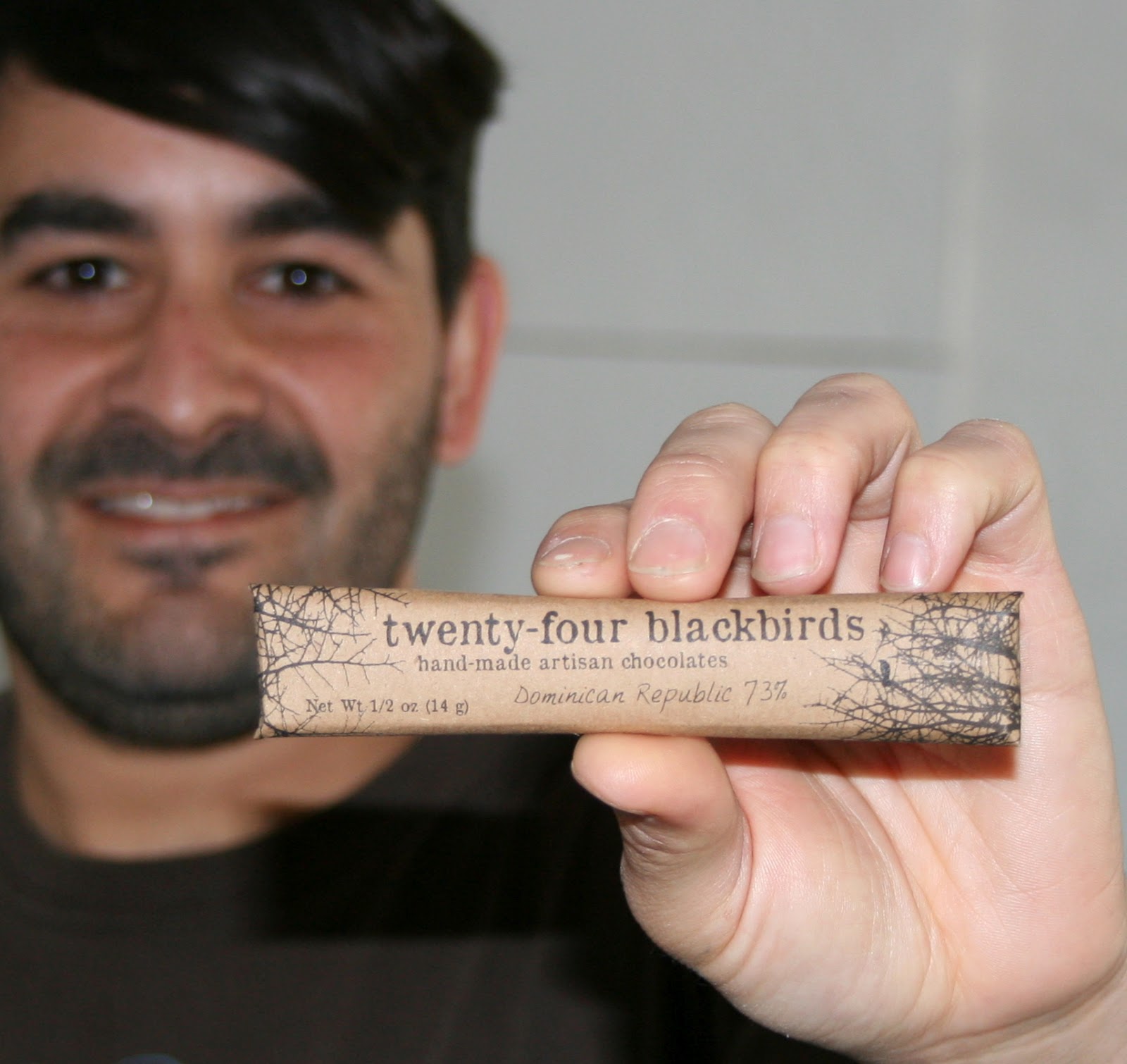
The most recent addition is Twenty-four Blackbirds. What sets them apart is that owner Mike Orlando actually makes his chocolate from raw beans. The others buy bulk chocolate, then change/add ingredients to suit their preferences, but Orlando buys raw beans from places like Peru, Madagascar and the Dominican Republic, roasts them, crushes them, refines them and molds them into bars. It’s a time consuming process but he is one of the few people in the U.S. to make chocolate by hand. A former analytical chemist at UCSB he’s well adapted to the specificity of the tedious process. What you get is cocoa and sugar, that’s it; chocolate bars that are hand signed by lot number and expiration date. And his chocolate is probably the purest expression of original cocoa - deep, bittersweet and fast becoming an obsession around town. Telegraph Brewing Company has partnered with him to make a chocolate beer. His bars sell for $2.50 and you can find them at The French Press, Pierre Lafond in Montecito, and Chocolate Maya.
Mike Orlando Makes Bean-To-Bar Chocolate

For additional cool info about cocoa in Santa Fe, New Mexico, check out my other blog, www.Exploracation.blogspot.com


Sample These Places!

Wednesday, February 22, 2012

Alsace in America: Mendocino Memories


So, what if there were a wine festival which was unpretentious, fun, not the least bit crowded, where international winemakers and their wines congregated together, all set in beautiful surroundings and was, well, just way cool? Well there is. The International Alsace Varietals Festival arrives each February in Mendocino (slightly north of Sonoma), and with it, a die-hard contention of Riesling, Gewürztraminer, Muscat, Pinot Blanc and Pinot Gris enthusiasts. And we’re not talking flabby sweet wines which taste like packets of Equal mixed with water. We’re talking serious non-sweet, semi-sweet and luscious sweet white wines which will literally change your mind about what a white wine can be. There has long been a belief that these kinds of wines are simplistic and that “serious wine drinkers drink red,” but that is nothing more than a short-sighted, myopic view, plagued by insecurity. All wines, white, sweet, red and bubbly, have a place on your table.

Life is not all Chardonnay and Sauvignon Blanc, it can be, but frankly, aromatic white wines should be part of what you are drinking on a regular basis. This is a small conference but it packs a mighty punch. It begins with a technical conference; a kind of wine-geeky gathering of detailed, though interesting, information on these wines with about 100 people. This is followed by a grand tasting, with winemakers on hand to pour and talk about their wines. And this is the inherent beauty of this particular festival; it’s small, accessible and dedicated to, not to a wide variety of wines, but a focused presentation of a select few, which gives you the chance to really hone your understanding of these varieties. The technical conference also presents unique one-of-a-kind opportunities. For 2012, the New Zealand Riesling Challenge allowed attendees to sample 12 different iterations of Riesling, made by 12 different winemakers from New Zealand who each made Riesling from grapes from a single vineyard. Given there were so few cases produced, and the majority of those were kept inside the country, this was a rare and very cool chance to taste how 12 people interpret one wine made from one plot of land.
Fresh made pizza is at the Festival

But Mendocino is not just aromatic whites. Many of the wineries which line Highway 128 are making some killer juice. Foursight Wines, located in Boonville, is a prime example of this. Making Sauvignon Blanc, Semillon and Pinot Noir, their bottle prices range from $20 to $46 and since this is a family-owned operation, one of the family always staffs the small tasting room. They are fourth-generation farmers, producing fewer than 2,000 cases of wine, and the tasting room sits on the site of an old farm house when this land used to be a sheep ranch. Probably an anomaly for the region in terms of aromatic whites, they don’t often produce one. Owner Kristy Charles and her husband Joe Webb started by making wine for themselves at first, just one barrel actually, sharing it with their friends, then slowly expanded to a commercial venture. They are the first tasting room in Boonville and a highly recommended stop. The tasting fee is a mere $5.
Kristy Charles at Foursight Wines
Up the road, just passed the blink-and-you-miss-it town of Philo in what is called the “deep end” of the Anderson Valley (a cooler more fog-laden area) Handley Cellars has been making wine for three decades here. Chardonnay, Riesling and Pinot Noir are their strong suits and with diurnal swings of 50 degrees (the extreme highs and lows of a daily temperature flux) there is a clear acidity in their wines which is crucial for wines which work well with food. I was fortunate enough to taste 10 year-old Rieslings with co-winemaker Kristen Barnhisel, and I mention this because the Rieslings held up stunningly well. They make 12,000 cases a year, using a dedication to a restrained style of wine. These are not big alcohol bombs, but, true to the region, are delicate wines, both whites and reds. I also barrel tasted through several Pinot Noirs. Their bottle prices range from $15 up to $52. Both Handley and Foursight farm their vineyards as certified organic and are definitely worth a visit when you head to the Anderson Valley.
Kristen Barnhisel of Handley Cellars

For additional info on the Mendocino wine region, get a paperback copy, or download an e-book copy of my travel book, “California Wine Country.” Copies are available nationwide, and at: http://www.amazon.com/Moon-California-Wine-Country-Handbooks/dp/1598805959

Fresh shucked oysters are always a hit at the Alsace Festival