Showing posts with label father junipero serra. Show all posts

Thursday, February 13, 2014

Of Missions, Meat & Movies: Mission San Luis Obispo


Mission San Luis Obispo de Tolosa was named after Saint Louis (no, not the city) who was the Bishop of Toulouse in France and was founded in 1769. Let’s stop there. “Founded” merely meant a prayer was said, a cross stuck into the ground and that was pretty much it. The Spanish who controlled California used the chain of missions to not only bring religion to the New World, but the missions acted as trading posts in the once rugged and desolate California landscape.


But hang on. Why here exactly? On September 7 and 8, 1769 Gaspar de Portola and his expedition traveled through San Luis Obispo on their way to the Monterey Bay. The expedition’s diarist, Padre Juan Crespi, recorded the name given to this area by the soldiers as “llano de los Osos” or the “bear plain,” as there used to be a whole hell of a lotta bears here. In fact, Los Osos, just west of San Luis Obispo, still holds that name.
 
Father Serra and the SLO Mission
Skip forward to 1770 and Father Serra founded Mission San Carlos Borremeo in Monterey (it was moved to Carmel the following year.) As the Monterey mission’s supplies dwindled in 1772 soldiers, padres and Native Indians faced starvation. Remembering the bear plain where they had stuck a cross into the dry earth years before, a hunting expedition was sent to San Luis Obispo to bring back food in the summer of 1772. Over 25 mule loads of bear meat was sent up coast to the Carmel Mission. It was after this that Father Serra decided that San Luis Obispo would be the ideal place for a fifth mission. The region had abundant supplies of food and water, the climate was mild, and the local Chumash were very friendly, until, you know, they were enslaved. Given these conditions, Father Serra set out on a journey to reach the bear plain and on September 1, 1772, he celebrated the first mass near San Luis Creek.

After Father Serra left, the task of building the mission remained which was accomplished primarily by the hard work of the local Chumash Indians – as in cheap labor. The church and priest's residence were built by 1794, and other structures made up the primitive mission in the early days, namely storerooms, residences for single women called a “monjerio,” barracks and a few
A photo of a photo, but historically cool
mills. The mission also used the land for farming and raising livestock since all missions depended upon whatever they produced for their survival. Expansion proceeded for a few years due to the prosperity of the mission, but those days were numbered and Mission San Luis, like all the other missions, gradually fell into disrepair in part because Spain stopped sending money to fund the California missions. When Mexico won independence from Spain in 1821 the missions were “secularized,” decommissioned as it were, and often mission lands were sold off. Governor Pio Pico sold the San Luis Obispo Mission to Captain John Wilson for a mere $510 in 1845, about $15,500 in today’s dollars, still a seal (though the actual church was not included in the deal). The building served multiple functions, even as a jail and the first county courthouse. It was returned to the Catholic Church in 1859.
Still an active church the mission is open daily

Today the mission fronts Mission Square (where parts of the Sandra Bullock film, Murder by Numbers was shot – no pun intended) facing the creek, and Higuera St. The courtyard is a popular place for small gatherings and festivals. The interior of the mission is minimally decorated, mainly hand painted. The whitewashed interior walls of the church are enlivened by a brilliantly hued “vine of life,” a reproduction of the original decor. The original floors were packed earth back in the day, colored red with cinnabar. Now of course it’s colored concrete. Still an active church, mass is held each day at 7 a.m.


A visit to the mission museum will set you back $3, and it’s worth the cost. The original mission doors are located, ironically, inside the museum on display and were used up until 1948. The museum is surprisingly large but it’s not all mission era stuff on display here. There is a good number of Indian artifacts; bowls and baskets, jewelry, pottery arrowheads and abalone shell pottery. There are mission-era vestments the padres wore, church artifacts and early 19th century clothes and personal belongings once the Westerners moved in to this region There are quite a few adobe cut-outs so you can see the exposed brick. The outside gardens are intimate with a water-well located center overlooked by Madonna Mountain. Clearly modernized landscaping with little green lawns does not reflect what it actually would have looked like and the mission itself is surrounded by Australian Eucalyptus trees.
A lonely portion of one of the original walls

For you true history buffs, walk across the street to the historical society building and there, barely seen or known about is part of the original mission wall – just a small chunk of authentic history waiting for someone to notice it. (MISSION SAN LUIS OBISPO, 751 Palm St., San Luis Obispo, 805/781-8220)

Thursday, March 1, 2012

Santa Barbara Sweet: Cocoa, Chocolate & Consumption


I don’t know anyone who doesn’t like chocolate. One of the favorite foods of our forefathers, who established this plot of heaven on the California Central Coast, was and continues to be, chocolate. Cocoa came to Alta California from Mexico transported on the backs of donkeys and Spanish padres. But these days you don’t need to work that hard to find exceptional chocolate.

Cocoa Then       
Chocolate was an integral staple of the Missions, from present day Texas, to Sonoma in California. Local Mission documents from 1779 through 1810 record the important use of chocolate and the padres routinely drank hot chocolate first thing in the morning before breakfast. Even father Junipero Serra, who founded Mission Santa Barbara, wrote about chocolate in the early 1770s. At the Santa Barbara Presidio residents had a variety of spices available to them and requisition records show that among the requests were cloves, saffron, cumin, and anise - coffee wasn’t requested until 1805. But chocolate was constantly ordered in large quantities and was asked for specifically from Caracas and Tabasco, Mexico, telling us that the concept that every place produces a product specific to its inherent ecology. There were specific pots associated with chocolate, many with locking lids due to the value of the cocoa it contained. The jerro chocolatero pots were made from copper and used to heat, then whip the chocolate into a drink. 
Copper Cocoa Pot

Chocolate Now
These days chocolate is easier to come by and Santa Barbara is home to four chocolate shops. Maya Schoop-Rutten learned chocolate making in her native Switzerland and her Chocolate Maya store, the only place she sells her chocolates, opened in 2007. She not only carries chocolate bars from places around the world, but the confections behind the glass are handmade by her using fresh local herbs. She hand decorates each individual piece and seeks out fair trade practices from whom she buys her bulk chocolate, and even travels to cocoa plantations across the globe to see for herself where the beans come from. “I need to know the origins of my chocolate,” she tells me. Her hand made chocolates are $2 a piece and imported chocolate bars range from $2.50 to $15 depending on origin and rarity.
Chocolate Maya and Maya Schoop-Rutten
Say chocolate in Santa Barbara and most people think Jessica Foster Confections. Foster started her company after working as a pastry chef at Bouchon. She has no formal training but has created a very successful business. Her truffles sell for $1.50 per piece and she hand rolls and hand dips 30 different flavors. You can find her truffles at Lazy Acres, Whole Foods, and Pierre Lafond in Montecito. But what exactly is a truffle? “It’s really a ganache filled bon bon,” Foster says, and they have nothing to do with the truffles dug up from the ground. She ships throughout the U.S. but also takes appointments in her small kitchen by request only. If you’re so inclined, and why wouldn’t you be, she offers a quarterly chocolate club. Milk chocolate salt and pepper, and her white chocolate Mayer Lemon are her top selling truffles.
Jessica Foster

For Jean-Michel Carre of Chocolats du CaliBressan it was the opposite story. Trained as a chef and owner of a restaurant in the Burgundy, France, cocoa was part of the long view. “I was always interested in chocolates when I was in France,” he says. He has 36 different flavors, many in molded shapes like the Buddha Beauties; soft salted caramels with a dark chocolate shell in the shape of a happy Buddha; and the Bisous- bright red lips filled with dark and milk chocolate ganache and tangerine liquor. Individual pieces sell for $1.75 at either of his two storefronts in Santa Barbara or Carpinteria. And Cali is the only place which offers a tour. The third Thursday of every month for $20 (you need to make reservations) you get a behind-the-scenes look at how chocolates are made, a little bit of history about cocoa and you taste several chocolates, all while sipping a glass of Champagne.
Jean Michel Pours His Molds
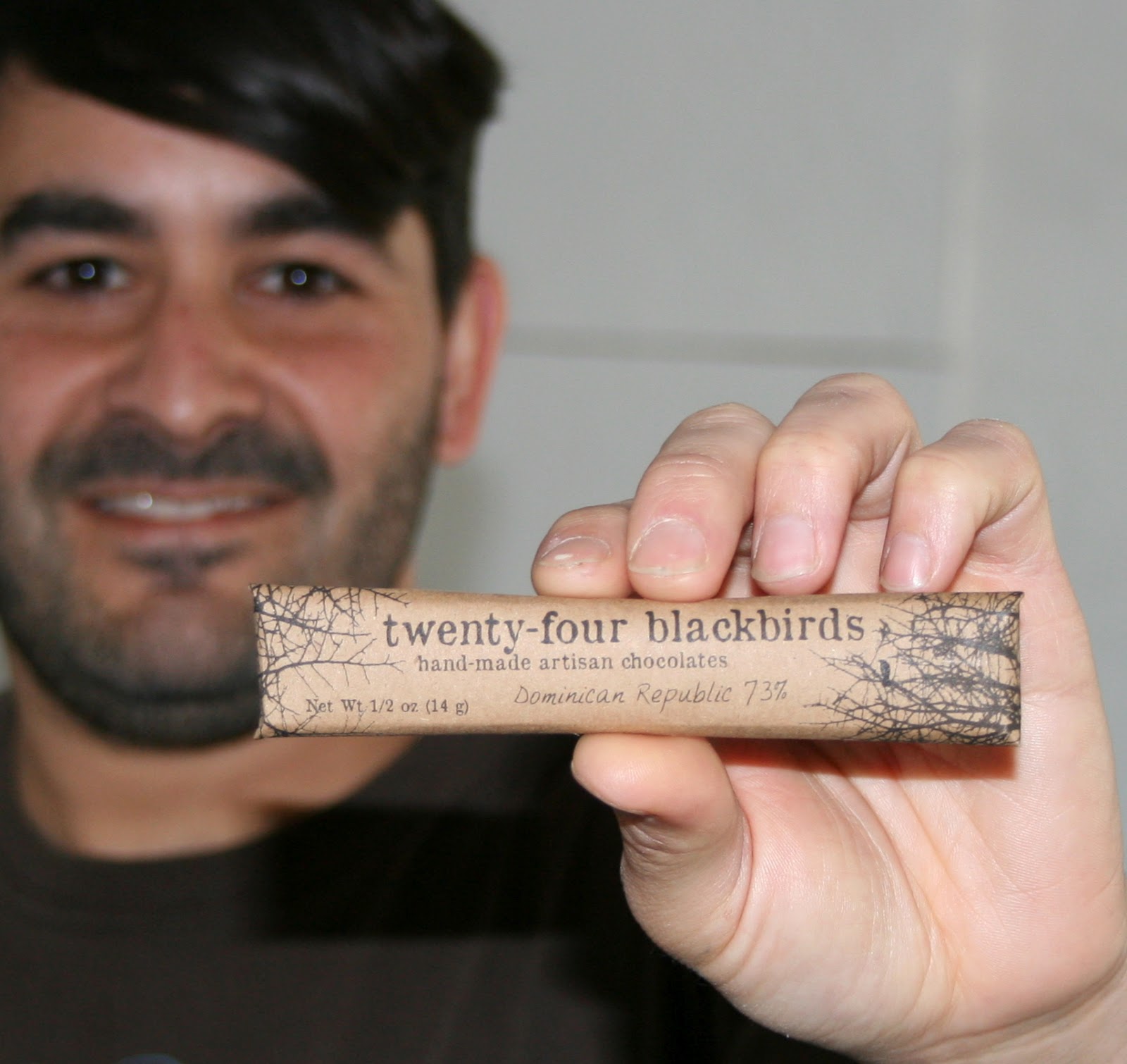
The most recent addition is Twenty-four Blackbirds. What sets them apart is that owner Mike Orlando actually makes his chocolate from raw beans. The others buy bulk chocolate, then change/add ingredients to suit their preferences, but Orlando buys raw beans from places like Peru, Madagascar and the Dominican Republic, roasts them, crushes them, refines them and molds them into bars. It’s a time consuming process but he is one of the few people in the U.S. to make chocolate by hand. A former analytical chemist at UCSB he’s well adapted to the specificity of the tedious process. What you get is cocoa and sugar, that’s it; chocolate bars that are hand signed by lot number and expiration date. And his chocolate is probably the purest expression of original cocoa - deep, bittersweet and fast becoming an obsession around town. Telegraph Brewing Company has partnered with him to make a chocolate beer. His bars sell for $2.50 and you can find them at The French Press, Pierre Lafond in Montecito, and Chocolate Maya.
Mike Orlando Makes Bean-To-Bar Chocolate

For additional cool info about cocoa in Santa Fe, New Mexico, check out my other blog, www.Exploracation.blogspot.com


Sample These Places!