Showing posts with label san luis obispo. Show all posts

Monday, December 1, 2014

Butterflies ARE Free: Monarch’s of the Central Coast


Butterflies: the wallflower of the insect world - I mean, who really notices these little floating soundless works of art? But these beautiful little creatures undergo one of the most amazing transformations from caterpillar to butterfly, something that I witness every year with the butterflies in my back yard. The Central Coast is home to three Monarch Butterfly Preserves where you can get up close, and somewhat personal with these beauties. And if you know little about them, I use this case study from my own yard in Santa Barbara, where my wife and I have specifically cultivated butterflies by planting milkweed. Eggs hatch on the milkweed plants, and the caterpillars consume, actually nearly decimate, the milkweed plant for food, all leaves and even stems. When ready the caterpillars find a place to spin their cocoon, and then form into butterflies, then return to lay eggs on the milkweed plant. It’s a cool cycle you can make happen in your yard.


In 2014 I noticed that after monitoring the caterpillars, one had decided to spin its cocoon on the doorjamb of the doorway into my garage. What astounded me was the trek this little guy made. From the milkweed plant it is 18-feet and 4-inches across my erratic, pot-holed lawn. From there he needed to climb up a 5-inch concrete rise to get to the top of the flagstone deck. Crossing the flagstone is another 9-feet and 3-inches to get to the garage door. Then he climbs straight up the door 8-feet, moves over 1-foot to settle comfortable (we hope) in the dead center of the top of the doorjamb. If you tally that up, it’s a total of 37 feet - a hell of a journey. What possess them I have no idea. Certainly some make their cocoon closer than this, but this is a reminder that nature offers a spectacular lesson if we choose to notice the small things. With a typical lifespan of a paltry 2 to 6 weeks (some live 6 months) when you see them, remind yourself of the singular beauty of life, the intense but short life stages they go through, and that the will to survive is strong. So wing on over to one of these Central Coast spots to take a closer look and be astonished by the world around you.
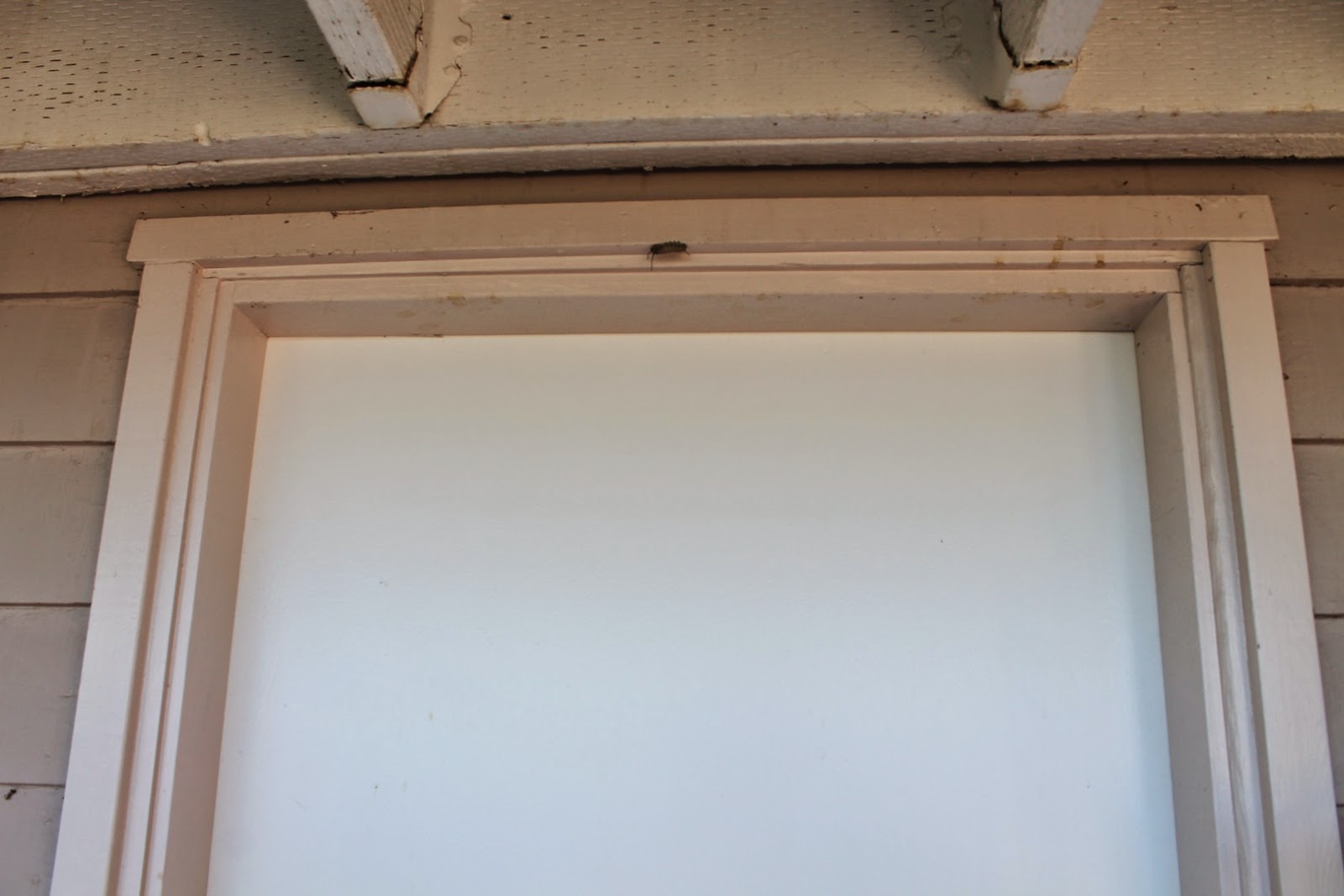
There he is! Smack dab in the middle of the garage door!

San Luis Obispo:
The largest butterfly preserve on the Central Coast is the Pismo Beach Butterfly Grove (Highway 1 just south of North Pismo State Beach Campground, 805/473-7220), which sees the return of butterflies each November through February when tens of thousands of Monarch’s migrate to this small grove of eucalyptus trees near the beach to mate. On average there are about 30,000 of these silent winged creatures and the trees are often transformed into brilliant shades of orange after their 2,000 mile journey to get here. Docents staff the area and give brief but fascinating talks about the butterflies and their very unique but short lives. It’s free to walk into the grove, free to hear the docents and there’s a short boardwalk that leads to the beach near a large picnic area where you hit the low sand dunes and cypress trees near the waters edge. Parking is along the side of the road so use caution when crossing as this is a busy street. Monarchbutterfly.org
This beauty just came out in my backyard

Santa Barbara:
Monarchs are usually found in Goleta from mid-November through mid-February and docents are available on weekends from 11a.m. to 2 p.m. during these months. This is the smallest of the three groves and is available for viewing every day during daylight hours and it’s free. The Goleta Butterfly Grove (Ellwood Main) is in the Sperling Preserve on the Ellwood Mesa in Goleta, just north of downtown Santa Barbara. Free parking is available. Goleta Butterfly
The grove in Pacific Grove, near Monterey

Monterey:
The Pacific Grove Monarch Preserve (1073 Ridge Rd., Pacific Grove) is located behind a salmon-colored butterfly-themed motel. There are, on average, about 10,000 butterflies that come here yearly, and why not, Pacific Grove is stunningly beautiful! The best time to view these silent creatures is October through March. There’s usually a docent on hand to answer questions and explain about the short life of these amazing creatures. There is a free street parking nearby and the grove is free to enter. Pacific Grove Butterfly
Also from my backyard. Absolutely stunning!

Thursday, March 27, 2014

The Granada Hotel Goes SLO


San Luis Obispo (known as SLO for short) is one of the coolest towns along the California Central Coast. South in Santa Barbara you have wine and waves and north in Monterey you have rugged rocks and the Bay. But SLO is set inland, 8 miles from the beach flanked by the low rolling hills and dormant volcanoes. Historically filled with a mix of B&Bs, chain hotels and a few family-owned spots, it has always lacked the kind of lodging with a mix of hip and trendy with historical cool…until now.


The Granada Hotel & Bistro has opened its doors. Originally built in 1922 and operating as a hotel, it was located next to a theatre and was thought to be part of the red light district. Regardless of that tidbit, there is a speakeasy feel to place, a nod to the roaring 20s. Today the Granada has the only rooftop lounge in San Luis Obispo. In the mornings from the trees that front the building you can hear flocks of black birds carrying on, a happy, natural wake-up call. During my stay I stood out on the second floor balcony not only watching the birds, but the slow steady rhythm as day began and the ever-increasing people began to move about this compact city.
The Granada Hotel is all about the moody details

The Granada succeeds because it is cool and hip without trying to be cool and hip. The attention to detail with rich hardwoods, exposed brick walls and small noticeable elements like door handles, and light fixtures are all perfectly suited for this space. It creates a blend of vintage with an almost European sensibility. Upstairs the rooftop lounge has an outdoor fireplace, a perfect spot for the morning coffee ritual. Nearby a small blue phone on the telephone table allow guests to order something directly from the bistro downstairs, like it’s your personal Bat Phone. The rooms here are small; “intimate” would be the word used by the hotel, and they are that, but they also feel just about right with an intelligent design for the space to maximize the room. The accompanying bistro located on the first floor has original tin pressed ceilings, a small bar, a large communal table and a terrific outdoor patio for day or night dining. This is quite honestly the nicest property in all of San Luis Obispo to stay.


There is also the Art Bar located next door. Wine, beer and charcuterie ($40) are provided in a two-hour class where you can tap your inner artist. Local artists guide you through a version of their own painting and though you may imbibe the wine, no one will judge you on the outcome of your painting, even if it looks nothing like the original. There is also a small spa on site and given the roped off access and dark curtains to keep non-guests at bay, you feel as if this is your own private club.

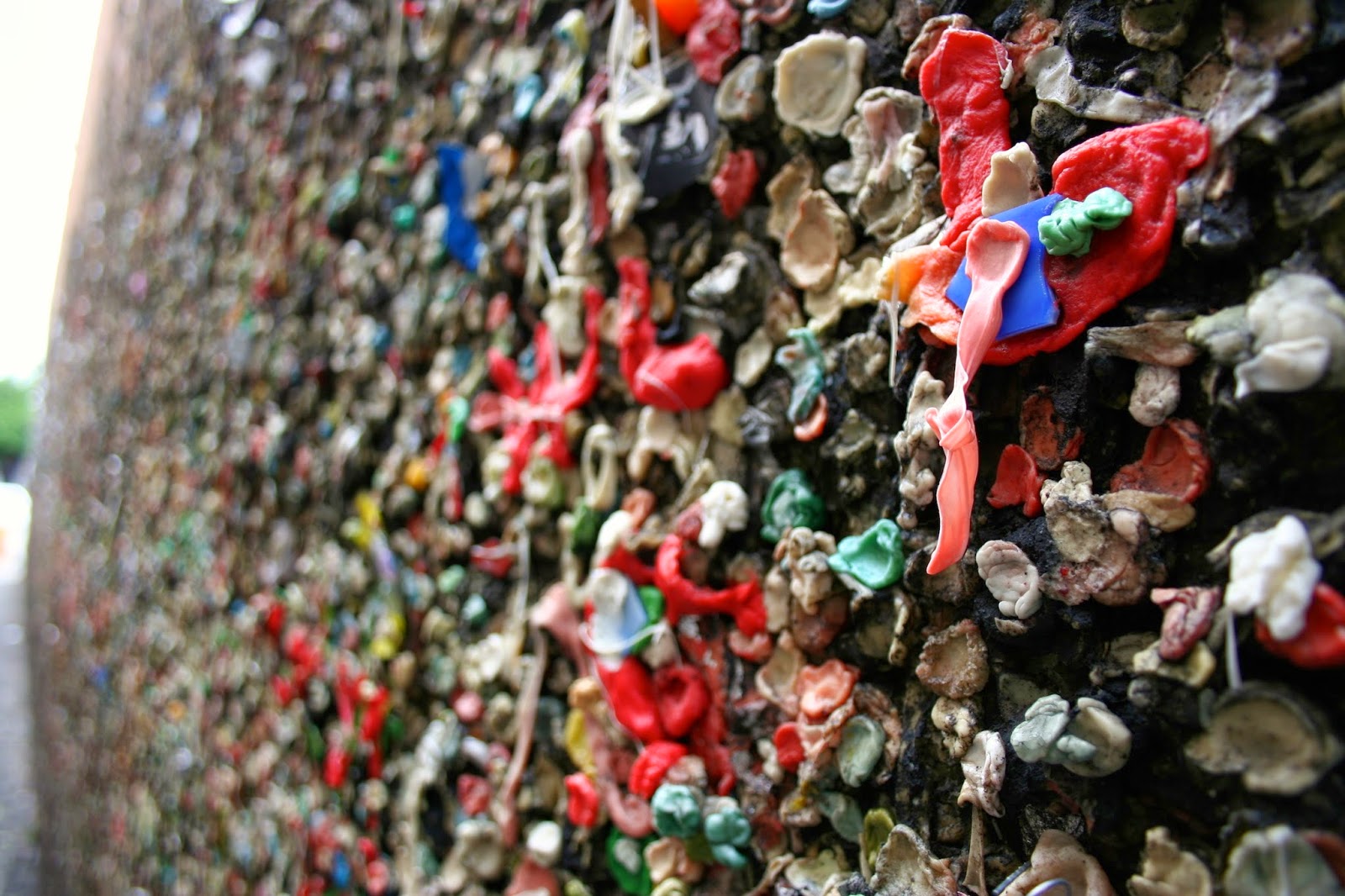
Bubblegum Alley is a must see.
And of course, you’re right downtown a few steps off Higuera Street so you can walk to most everything. A few additional things to do: check out Bubblegum Alley (700 block of Higuera Street) a sticky, if unusual, landmark. It doesn’t resemble anything but what it is; tens of thousands of wads of multicolored gum rejects squished one on top of another in a masticated mosaic some 70 feet long and 15 feet high. It is urban pop art, a unique expression of individuality in the form of chewing gum. Some people seek to make a statement, spelling out their love, their hopes, or merely pressing tasteless gum onto a wall. Some find this disgusting, but it is modern art in gum form, yes, used art, as it were. There are gum dispensers on either side of the alley and for a mere 25 cents, you can add your chewed up message to the ages. Don’t pass by and pass judgment, walk the alley and observe.
The author at the summit of Madonna Mountain

And take a hike up Madonna Mountain for awesome 360 views which will take you an hour to reach the top, and in spite of the hike being all uphill, it’s worth the effort to have so much of the Central Coast splayed out before you. So consider SLO as your next destination, but book the Granada for your lodging. 

Check out my post on the San Luis Obispo Mission, close to the Granada here: MISSION SAN LUIS OBISPO

Thursday, February 13, 2014

Of Missions, Meat & Movies: Mission San Luis Obispo


Mission San Luis Obispo de Tolosa was named after Saint Louis (no, not the city) who was the Bishop of Toulouse in France and was founded in 1769. Let’s stop there. “Founded” merely meant a prayer was said, a cross stuck into the ground and that was pretty much it. The Spanish who controlled California used the chain of missions to not only bring religion to the New World, but the missions acted as trading posts in the once rugged and desolate California landscape.


But hang on. Why here exactly? On September 7 and 8, 1769 Gaspar de Portola and his expedition traveled through San Luis Obispo on their way to the Monterey Bay. The expedition’s diarist, Padre Juan Crespi, recorded the name given to this area by the soldiers as “llano de los Osos” or the “bear plain,” as there used to be a whole hell of a lotta bears here. In fact, Los Osos, just west of San Luis Obispo, still holds that name.
 
Father Serra and the SLO Mission
Skip forward to 1770 and Father Serra founded Mission San Carlos Borremeo in Monterey (it was moved to Carmel the following year.) As the Monterey mission’s supplies dwindled in 1772 soldiers, padres and Native Indians faced starvation. Remembering the bear plain where they had stuck a cross into the dry earth years before, a hunting expedition was sent to San Luis Obispo to bring back food in the summer of 1772. Over 25 mule loads of bear meat was sent up coast to the Carmel Mission. It was after this that Father Serra decided that San Luis Obispo would be the ideal place for a fifth mission. The region had abundant supplies of food and water, the climate was mild, and the local Chumash were very friendly, until, you know, they were enslaved. Given these conditions, Father Serra set out on a journey to reach the bear plain and on September 1, 1772, he celebrated the first mass near San Luis Creek.

After Father Serra left, the task of building the mission remained which was accomplished primarily by the hard work of the local Chumash Indians – as in cheap labor. The church and priest's residence were built by 1794, and other structures made up the primitive mission in the early days, namely storerooms, residences for single women called a “monjerio,” barracks and a few
A photo of a photo, but historically cool
mills. The mission also used the land for farming and raising livestock since all missions depended upon whatever they produced for their survival. Expansion proceeded for a few years due to the prosperity of the mission, but those days were numbered and Mission San Luis, like all the other missions, gradually fell into disrepair in part because Spain stopped sending money to fund the California missions. When Mexico won independence from Spain in 1821 the missions were “secularized,” decommissioned as it were, and often mission lands were sold off. Governor Pio Pico sold the San Luis Obispo Mission to Captain John Wilson for a mere $510 in 1845, about $15,500 in today’s dollars, still a seal (though the actual church was not included in the deal). The building served multiple functions, even as a jail and the first county courthouse. It was returned to the Catholic Church in 1859.
Still an active church the mission is open daily

Today the mission fronts Mission Square (where parts of the Sandra Bullock film, Murder by Numbers was shot – no pun intended) facing the creek, and Higuera St. The courtyard is a popular place for small gatherings and festivals. The interior of the mission is minimally decorated, mainly hand painted. The whitewashed interior walls of the church are enlivened by a brilliantly hued “vine of life,” a reproduction of the original decor. The original floors were packed earth back in the day, colored red with cinnabar. Now of course it’s colored concrete. Still an active church, mass is held each day at 7 a.m.


A visit to the mission museum will set you back $3, and it’s worth the cost. The original mission doors are located, ironically, inside the museum on display and were used up until 1948. The museum is surprisingly large but it’s not all mission era stuff on display here. There is a good number of Indian artifacts; bowls and baskets, jewelry, pottery arrowheads and abalone shell pottery. There are mission-era vestments the padres wore, church artifacts and early 19th century clothes and personal belongings once the Westerners moved in to this region There are quite a few adobe cut-outs so you can see the exposed brick. The outside gardens are intimate with a water-well located center overlooked by Madonna Mountain. Clearly modernized landscaping with little green lawns does not reflect what it actually would have looked like and the mission itself is surrounded by Australian Eucalyptus trees.
A lonely portion of one of the original walls

For you true history buffs, walk across the street to the historical society building and there, barely seen or known about is part of the original mission wall – just a small chunk of authentic history waiting for someone to notice it. (MISSION SAN LUIS OBISPO, 751 Palm St., San Luis Obispo, 805/781-8220)

Saturday, May 28, 2011

Summer at the California Central Coast: Get Your Tan On!


Kayaking in Ventura Harbor
Say summer and you automatically think about being outside. Who stays indoors except for cranky people and vampires? The California Central Coast is prime outdoor territory for summer fun as this stretch of coastline from Ventura to Monterey is ripe with plenty to do. From tide-pooling, surfing, hiking and biking, to a romantic stroll as the Pacific tickles your feet, here are some suggestions to get out, get some sun and uncover the coast!


My wife over looking Potato Harbor on Santa Cruz Island
Perhaps the best playground for outdoor fun is to visit the Channel Islands National Park (www.nps.gov/chis/). These islands, just off the coast of Santa Barbara, are great day trips and get you back to pristine California as it was hundreds of years ago. Santa Cruz, Anacapa and Santa Rosa islands are best accessed from Ventura Harbor. All three islands have indigenous plants and animals, such as and the smallest fox you’ve ever seen, the Channel Islands Fox, and over 140 other species found no where else on earth. You can camp overnight, or spend a day or half-day roaming the place on moderate hikes with a trained naturalist. Island Packers is the official concessionaire and they do a great job of getting people to and from the islands. WATCH my 2 Minute Travel video shot on Santa Cruz Island here:http://www.youtube.com/watch?v=0jf7Va2jxbA&feature=plcp

Guided kayaking tours of the Channel Islands by folks like Blue Sky Wilderness (http://www.blueskywilderness.com/) gets you up close to the volcanic rock and sea caves on the islands, including Painted Cave, one of the largest sea caves in the world, located at Santa Cruz Island. Picnic on the island and explore parts few people have walked on. Though the waters are cooler, you can also snorkel off all three islands and immerse yourself near the kelp forests. You’ll spot the California State Fish, the Garibaldi, see sheepshead, and other cool sea life. Or if you dive, the islands are great spots to scuba. I usually dive around Anacapa and the backside of Santa Cruz. There are sea lions, dolphins, crabs and everything else under the sea. Use the Peace Boat (http://www.peaceboat.com/) my favorite dive boat, which departs from Ventura Harbor. They are professional and best of all, after a long day of diving you can warm up in their on-board hot tub while eating ice cream! Of course, you can always kayak within the confines of any of the harbors, like Ventura, Santa Barbara and Monterey for a more sedate experience.

The Channel Island Fox
Aside from the Channel Islands, here are other great Summer suggestions:

Biking:
The bike trails that hug the Central Coast are inspiring. The Waterfront in Santa Barbara is one of the best. You can rent a bike or surrey and leisurely follow the ocean down to the Andree Clark Bird Refuge, which passes the Santa Barbara Zoo, beach volleyball nets and languid palm trees. It’s flat, fun and you won’t break much of a sweat. In San Luis Obispo, the best spot for hiking, walking and biking is Montaña de Oro Park: 8,000 acres of coastal bluffs and coves to mountainous shrub-covered hills to lush valley’s of dense eucalyptus groves. It’s beautiful and truly a gem on the Central Coast. (http://www.slostateparks.com/montana_de_oro/default.asp).  

Beaching:

Carmel City Beach
The white sand beach at Carmel City Beach is immensely popular and within walking distance of downtown Carmel (www.Carmelcalifornia.com/). The views north are to Pebble Beach, and south you can see Point Lobos, another great hiking park. Walk, bring the dog and relax, then head back to Carmel for lunch, or wine tasting in Carmel Valley. Leadbetter Beach is one of the best beaches in Santa Barbara because it has a large grassy area with picnic tables, some shade, restroom facilities and outdoor grills. Plus you’re a short drive to State Street, Santa Barbara's main drag for shopping, outdoor dining and the SB vibe. Moonstone Beach in Cambria has long been popular due its more rugged coastline and handicap accessible boardwalk which runs the length of the low bluffs. There is also beach access, restaurants are close by, and restroom facilities are located at both ends of the beach. Plus you can find, yes, moonstones. You might also see otters.


Boating: 
My whale watching boat leaving Morro Bay
Whale watching in Santa Barbara, Ventura, and Morro Bay can be an awesome experience and these spots have reasonably good chances of getting pretty close to humpback and blue whales. There are numerous boats to take you around, either by sail, on a catamaran or on a traditional fishing boat. Having seen whales up close, it’s an experience you don’t want to miss. Of course, no one can promise you a whale sighting, but if nothing else, you’re floating on the Pacific, and that ain’t too bad!

Or, if you’re the more adventurous type, the Bella Monterey Bay (http://www.bellamontereybay.com/) is a great sailing boat which holds only 6 people and tours the bay and shoreline of Monterey. This is not for the faint of heart as this baby sails, which means it can get choppy on the open ocean and you will have to gingerly navigate your way around the vessel, depending on the wind, but you’ll have a blast.

Renting a surry along Santa Barbara's coastline
On Board Nautical in Morro Bay (http://www.onboardnauticalevents.com/) is for those who just need a relaxing ride on the water without spilling their cocktail. Chef-prepared foods and live entertainment on this classic 1960s yacht means you can kick back as you cruise inside Morro Bay gently and slowly, staying within the confines of the protected bay. For other great information about the Central Coast, check out all 4 of my travel books, in paperack and as a download on Kindle: http://www.amazon.com/Michael-Cervin/e/B004APYU4S

Friday, February 4, 2011

Wine and Waves & Bottles and Boards: The Central Coasts' Surfer/Winemakers


Some of the Central Coasts' Surfer/Winemakers

There has long been a romantic ideal attached with winemaking; the handcrafting, the upscale image, the near rock-star status associated with being a winemaker. Conversely, there has consistently been a slacker image attached with surfing; days wasted by the ocean, a frivolous lifestyle, and the ubiquitous use of the word “dude.”  But there are similarities between these two diametric opposites. The Central Coast is home to a number of winemakers who surf, or depending on your perspective, surfers who make wine. Some of them recently discussed the congruent nature of hang time and hanging ten.

Hanging out at Leadbetter Beach in Santa Barbara 

From Santa Barbara, Craig Jaffurs of Jaffurs Wine Cellars, Etienne Terlinden from Summerland Winery, Seth Kunin of Kunin Wines, Mike Brown of Kalyra and Steve Clifton of Palmina, joined forces with San Luis Obispo and Paso Robles guys; Craig Shannon of Per Bacco Cellars, Steve Kroener from Silver Horse Winery, Josh Beckett of Peachy Canyon, and Eric Ogorsolka of Zenadia Cellars. They each brought their wines, their boards and their thoughts on both. Steve Clifton grew up in San Clemente and the ocean has always been a part of his life. “Both surfing and winemaking have given me a relationship with nature, to understand its cycles, seasonal changes and how the earth moves and breathes,” he says. "It’s still the one and only place I feel truly relaxed and removed from the stresses of everyday life." Etienne Terlinden has the same affection for the water. As an avid surfer and member of the U.S. naval reserves the sea is an integral part of his life both inside and outside the vineyard. “The oceans have a profound effect on climate which ultimately regulates our macro, mezzo and micro climates around the vineyards. Winemakers, especially those who make pinot noir and chardonnay in Santa Barbara, realize the great quality of wines grown in proximity to the coast,” he says. “I appreciate the importance of the sea to make my living as a winemaker. I live my daily life in awe of its force," Terlinden adds.  

A perfect afternoon to shoot the breeze and sample each others wines
 Both surfing and winemaking have their ups and downs and often there are long bouts of tedium. “Surf travels with long flat spells,” Josh Beckett says. “It's frustrating and tiring but the surfer keeps going back for more, searching out new destinations.” He admits that the similarity in winemaking is that he’ll go for weeks on end with no days off during harvest. “As a surfer I look for the perfect wave, as a winemaker I'm searching for the best fruit," he says. Craig Shannon smiles and nods. “Paddling into a wave is like tasting a wine with all your senses keyed in,” he states.  There is a murmur of agreement. “During harvest," Jaffurs adds, “I'll check Jalama Point at dawn, then visit my Lompoc and Santa Maria vineyard sites before returning to the winery in Santa Barbara.” It makes for a long day, but he wouldn't trade is for anything.

For all surfers, the ocean can be fickle, creating a sense of danger as well as a natural high. But there is something more, something spiritual and grounding. “There is mostly a feeling of calm and clarity I get from surfing,” says Eric Ogorsolka. “This helps open a door into my creativity when I’m at the winery. Winemaking is hard work, but there are moments that take finesse, an artistic ability. Anyone can make wine, but it takes a little talent to put together a wine with style and grace.” He pauses and looks at the amber sun as it kisses the horizon. “When I surf I like to feel the wave beneath my feet and ride it out, not tame it or slap it into submission. It’s the same with my winemaking; I’m not attacking the grapes but guiding them along the path, riding them out," he says.

The benefits of a hard day surfing and making wine!
Craig Jaffurs is the most poetic about bottles and boards. “My best days at the winery always come after the best morning surf. The same joy I get surfing at dawn is the same joy I get walking a vineyard, tasting through barrel samples or just opening the roll up door at the winery.” Though surfing inspires and anchors each of these guys, ultimately it doesn’t pay the bills. “Look, when the surf comes up and I need to make wine, I make wine,” Jaffurs confesses. “The surf will be there another day, but the windows to success in winemaking are fleeting. You only get one chance a year to catch the perfect harvest.”
When you visit the Central Coast, be sure to check out these wineries, and toast them with a glass of wine while you’re at the beach. Wine and waves are just part of the Central Coast lifestyle. Come explore!