Saturday, March 16, 2013

Arroyo Hondo Preserve: Hiking Through Time


I am not a botanist. Nor do I pretend to know much about native plants, habitat restoration, or land use regulation. Regardless I committed to a 10-week program of habitat restoration at the Arroyo Hondo Preserve along the Gaviota Coast; that stretch of sun baked coastal land which extends from Santa Barbara out to where Highway 101 turns inland. This 30 mile stretch is one of the last un-spoiled tracts of coastal land in California and is a multitude of agriculture pasture lands, canyons and pristine beaches.

At 782 acres the Arroyo Hondo canyon looks deceptively small. The earliest known inhabitants of Arroyo Hondo were the Barbareno-Chumash civilization going back about 5,000 years. When Spanish explorer Juan Rodriguez Cabrillo sailed through the Channel in 1542, his team recorded a camp of the Native Americans located here at the mouth of Arroyo Hondo creek. Just 227 years later when the De Anza expedition actually walked this area, the village at Arroyo Hondo was abandoned. Of course the arrival of the Spanish spelled doom for the Chumash, maybe they understood that.

Rancho Arroyo Hondo was part of the original 26,530-acre Rancho Nuestra Señora del Refugio Mexican land grant to former Santa Barbara Presidio Commandant Jose Francisco Ortega in 1827 – that’s quite a gift by today’s standards. Only three families have owned this land since the Chumash first inhabited it and the adobe house on the property was built in 1842 by the Ortega family and was used as a stagecoach stop on the route between Lompoc and Santa Barbara in the late 1800s and the old road (since there was no freeway or railroad crossing) passed by the adobe. There is a small museum inside, two rooms actually, mainly photos and a few scrapbooks providing some history. 

Undoubtedly because of the narrow canyon at Hondo and its streamlined views down to the road it became a refuge for outlaws including Joaquin Murrieta, known to have murdered at least one man (Murrieta was killed by a posse in 1853 at his headquarters near Coalinga), and Jack Powers who terrorized travelers after the gold rush. Therefore you have the aptly named and best hiking trail here- The Outlaw Trail which takes you from the mouth of the canyon far up into the mountain with killer views. The trail is really two parts, a low key stroll through Hollister meadow and a slight incline which stops at a small grass clearing. Housed there is a wood picnic table placed strategically so you can rest and enjoy ocean views. If this seems taxing, don’t bother with the rest of the trail. From here it ascends sharply into the mountains and you leave behind the lush meadow by the stream and as you ascend the vegetation becomes more sparse, low to the ground, the heat becomes more pronounced, and the land more unforgiving.
Views along the Outlaw Trail

Heading up the Outlaw Trail you pass through successive layers of rock formations, some estimated to be about 40 million years old. At the top are sweeping views and a cool malformed sandstone outcropping looking more like Swiss cheese with holes and tunnels permeating its core, where you can stand and feel like you own the whole world. The views to the Pacific and the Channel Islands are unsurpassed. It’s just you and the random hawks and turkey vultures who silently soar above you. To your left is the Tajiguas landfill (which one local paper described as the “prettiest and most expensive landfill” in the tri-counties) and the peculiar juxtaposition of two canyons, one a nature preserve and one a garbage dump, is amusing, if not a little sad. But then that’s exactly the point of keeping Arroyo Hondo in perpetuity. This canyon won’t end up being a dumping ground for our insatiable need to waste things.

Looking down the canyon from the top of Outlaw
During my 10 weeks at the preserve I weeded, hoed, planted “native” plants under the direction of botanist Darlene Chirman, weeded again, mulched, watered, and tediously weeded again. I was curious about restoration, after all, what are “native” species and how do you track a chronology of plants? The rule of thumb in California is that native plants refer to plants here prior to the arrival of the Spanish and the goal is to bring Hondo back to that close approximation. Once the Spanish came they began cultivating the land with seeds and cuttings from Spain and Mexico, forever altering the landscape. It seems futile in some regards to get back to that point in time, and certainly with ubiquitous weeds piercing through the ground and the constant effort to root them out, it’s a perplexing task. But if left unchecked, this preserve, along with the plants and animals like mountains lions, newts, birds and fish that have long called this place home, would suffer from a changing landscape forcing them to retreat elsewhere.
Volunteers doing their thing

Perhaps that is the obvious nature of evolution and we should not try and maintain a piece of land, memorializing it from its heyday. Perhaps evolution demands we let nature take its own course, and that’s a viable argument. But after 10 weeks here I realize that we humans are stewards of this planet and the animals and plants in it. The work that restoration volunteers do here may not stop nature from what She wants to accomplish, but they are helping to preserve Hondo as it was before Westerners came along. The hope is that this place of natural beauty and history will inspire others, and that, regardless of what might happen with building codes, zoning laws and property rights, this valuable section of the Gaviota Coast will remain unspoiled and available to everyone.


Hondo is open the first and third weekends of each month. There are free docent led hikes the first Saturday and third Sunday of every month at 10 a.m. There’s no cost to visit, but donations are gladly accepted. Advance reservations are required – simply do this on-line – as a way of knowing who comes out, in part because the gates get locked and you don’t want to be stuck here. From Santa Barbara north on Highway 101 Arroyo Hondo is four miles past Refugio State Beach. Look for the blue CalTrans call boxes spaced one mile apart on the right hand side of the highway. The Arroyo Hondo entrance is located immediately after call box 101-412.   ARROYO HONDO PRESERVE


Sunday, December 2, 2012

Monterey's Mission

The beautiful Carmel Mission

Monterey may be the bread basket of America (the Salinas Valley is one of the most fertile places in the country), and home to Cannery Row and the fantastic Monterey Bay Aquarium and neighbor to Carmel and Big Sur, but it’s also home to three historic California Missions, all wildly different, two of which you’ve probably never visited. Many people forget that Spain ruled this area for over 200 years and the Spanish were on California soil in the mid 1500s. It is the chain of 21 Spanish missions that, in essence, created the blue print for what eventually became California. In fact Highway 101 was originally the dirt road that connected the missions known as El Camino Real – “the king’s highway” - and the mission themselves acted as early trading posts and historical repositories.
Sunday services at Carmel

San Carlos Borromeo de Carmelo Mission –Carmel’s Crown
Known succinctly Carmel Mission (3080 Rio Rd., Carmel, 831/624-1271, Daily 9:30 a.m. to 5 p.m., Admission $6.50), is still a very active parish with regular Sunday services (all three missions offer mass). The large compound includes an extensive museum with the first known library in California still on display – courtesy of the mission fathers who were the first librarians and historians in California as not much else existed in the late 1700s. There are exhibits of early Native American culture, building materials from the mission period, vestments and displays on how the friars lived and cooked. The chapel is more ornate than the other California missions and it’s clear that a lot of money has been spent on upkeep as the place looks nearly pristine and the grounds are expansive and beautiful. It can get crowded, making parking out front difficult, but the mission is just on the outskirts of Carmel.

Mission San Antonio - the olive tree is at right
Mission San Antonio de Padua –Lost in Time
The third mission started in California’s chain of 21 is Mission San Antonio founded in 1771 (Fort Hunter Liggett, 831/385-4478, Jolon, daily 10 a.m. to 4 p.m., Admission $3). It’s commonly referred to as “the mission that time forgot” and that’s unfortunate, but here’s why - it’s 25 miles off Highway 101. The location is remote and it sits on the Fort Hunter Liggett U.S. Army base which the public can access (have your drivers’ license and proof of insurance ready – you cannot get on base without them). Look for the original brick wine vat, constructed between the late 1700s early 1800s, which uses a gravity flow system. This was one of the first missions to produce wine and the interior courtyard has a large vine by the well which is originally from Spain, lugged over here when the missions were founded. Several other rooms display artifacts like embroidered vestments, mission era tools and priests’ quarters. 
This grapevine was brought over from Spain by the padres

There are also remnants of the old waterworks and a beautiful large olive tree planted in 1846 right out front. The church itself is longer than most, but simply decorated, with painted wainscoting along the walls. The mission was damaged in a recent earthquake and the race is on to raise money for much needed restoration or else it will be shuttered, and we’d hate to lose a valuable piece of history. You may say toy yourself: why should I drive all the way out there to visit just an old mission? Well, aside from the historical significance, also located nearby is the old Hearst Hacienda – a ranch house on the former William Randolph Hearst property, designed by Julia Morgan and where Hearst would take his guests (Clark Gable and Errol Flynn stayed here) on horseback who were sojourning at the Hearst Castle. The Army bought it from Hearst in 1940 but you can stay the night here in one of the old ranch rooms. They are pretty Spartan, but you can also access the military bowling alley nearby for some food and maybe bowl a frame with a general. Room rates range from $50 to $95. You need to contact the Morale, Welfare and Recreation division of Fort Hunter Liggett and make reservations directly with them.
The Hearst Hacienda

Mission Nuestra Senora de la Soledad –Solitude in Soledad
Founded in 1791, Mission Soledad (36641 Fort Romie Rd., Soledad, 831/678-2586, daily 10 a.m. to 4 p.m., free admission) was the 13th in the chain of 21 missions. It too is one of the least visited missions even though it’s less than three miles off Highway 101 in Soledad (take the Arroyo Seco exit off Highway 101) and is an easy visit on the way to several of the area wineries. 
Mission Soledad
Every October there is a wine auction from mainly local wineries to raise money for restoration. The chapel is one of the smallest and most simple I have visited in the mission chains and the humble structure is surrounded by crop fields and you can see vineyards of the wineries in the Santa Lucia Highlands in the distance. It’s small and not as postcard-pretty as California’s other missions. The original mission was badly damaged in the floods of 1828, and wasn’t reconstructed until the early 1950s. But the original adobe walls can still be seen; mounds of rounded earth returning to the dirt from whence they came. In its day, the mission hosted a vineyard, fruit trees, and herds of cattle. There are a few rooms of artifacts on display from the mission days.
The original Mission Soledad walls

Check out this video I shot at Mission San Antonio in September 2012,
Monterey Mission Video
and make sure when you come to Monterey you find time to visit these missions as they are the link to California’s illustrious past.Contact them here:
Hearst Hacienda: (831) 386-2262

Tuesday, November 13, 2012

Paso Robles’ Garage: A Wine Festival for the Curious


Quick, here’s a word association: I say “garage” and you say “_______” (fill in the blank). Chances are you weren’t thinking of wine, let alone hard-to-find wines…unless you’ve lost your own wine in your own garage and if so, you’re on your own.

Garage bands conjure up images of unseen talent lamenting away in near obscurity before they make it big. And the same is true with winemakers. The term garagiste is from the French meaning, well, garage, and it has nothing really to do with garages with the exception of winemakers in that country who are making small lots of wine, a few hundred cases to maybe a thousand cases, and who defy conventional winemaking to do their own thing. Frankly anyplace you visit has undiscovered hard-to-find wines, but they’re not easy to find…wait, we just covered that. Fortunately, the Paso Robles Garagiste Festival does the gathering work for you, enabling you to meet face-to-face with these elusive wines and winemakers.
Relaxing at Windfall Farms

The 2nd iteration was held at Windfall Farms in Creston, just east of Paso Robles on a crisp autumn day. There were 48 winemakers pouring 130 wines so realistically you can’t cover everything, but I can say from my experience as a wine writer, I did not find a bad wine out of the limited wineries I was able to visit. The wineries represented make less that 1,200 cases, and most make considerably fewer cases than that and the majority are off the radar. “You have to do a little digging to find us,” Per Cazo Cellars owner Dave Teckman told me. The sheer diversity and small allocations are one of the reasons to come to this. There is a propensity towards Syrah and Rhone blends, as Paso does these quite well, but make no mistake, this is not the usual suspects. For example:
Phillip Hart of Ambyth

Ambyth Estates makes biodynamic wine from biodynamic grapes. There has been so much mis-information about biodynamic wine and whereas it’s a convoluted subject to go into here, the bottom line is that it goes beyond organic and frankly, anything that does not add chemicals to our soils is a good thing. Phillip Hart’s wines ($38 - $45) will absolutely change your perception about biodynamic wine and just how solid they can be. Other producers include Paso Port whose seductive port wines ($30 - $45) are flat out comprehensive and terrific little numbers, and Bodega de Edgar, a rather sloppy name (named for owner/winemaker Edgar Torres) but who makes impressive Tempranillo ($32) and Tempranillo blends, as does Bodegas M who produces excellent Albariño and Tempranillo, both at $25.

Also observed at this festival are some of the Iberian varieties such as Albariño and Verdejo, and fun, funky blends like the energetic ZinG ($29) from Per Cazo which is a blend of Zinfandel and Grenache, two partners you don’t see dancing together, showing that wine need not be merely a standard offering of straight Cabernet. Of course, having said that, Mike Sinor’s Sinor-La Valle’s Pinot Noirs (only $30 - $40 and worth every penny) are true, delicate and straight forward Pinots with a slight backbone of Central Coast roughness.

There are wine-centric seminars, winemaker dinners and the usual trappings of any wine festival, but what sets this apart is that these winemakers are celebrated for being obscure. So plan on attending and plan early, it always sells out.


Thursday, October 25, 2012

Santa Barbara’s Best Winemaker Dinner You’ve Never Attended


This is Santa Barbara - wine country - and there are winemakers dinners every week around here. I have attended my share of them as a wine and food writer and have seen every kind imaginable: fancy, rustic, celebrity chef, candlelight in the wine caves, blah, blah, blah. Often these wonderful dinners have the winemaker or winery owner present to talk about his or her juice, a fancy dinner, lots of loud guests and a tab which hits close to $150. Ouch. That’s a lotta bucks, but often these are 5 and 6 course affairs, with those specific wines paired with the food from said terrific kitchen. And yes, they are fun.

But what if there were a winemaker dinner series which had a specific theme (let’s say Oregon Pinot Noir versus California Pinot Noir; Cool-Climate Syrah versus Warm Climate Syrah, for example). And what if the winemaker was present talking and pouring his wine, but each guest also brought a bottle of wine tied in with the theme? (Simple math means that each guest or couple would amount to an additional 25 to 40 bottles of wine specific to the theme depending on how many guests show up). And what if the cost for the dinner wasn’t hovering well over a hundred bucks, but was priced at a stunning $50? Would you go? You bet your sweet dessert wine you’d go!

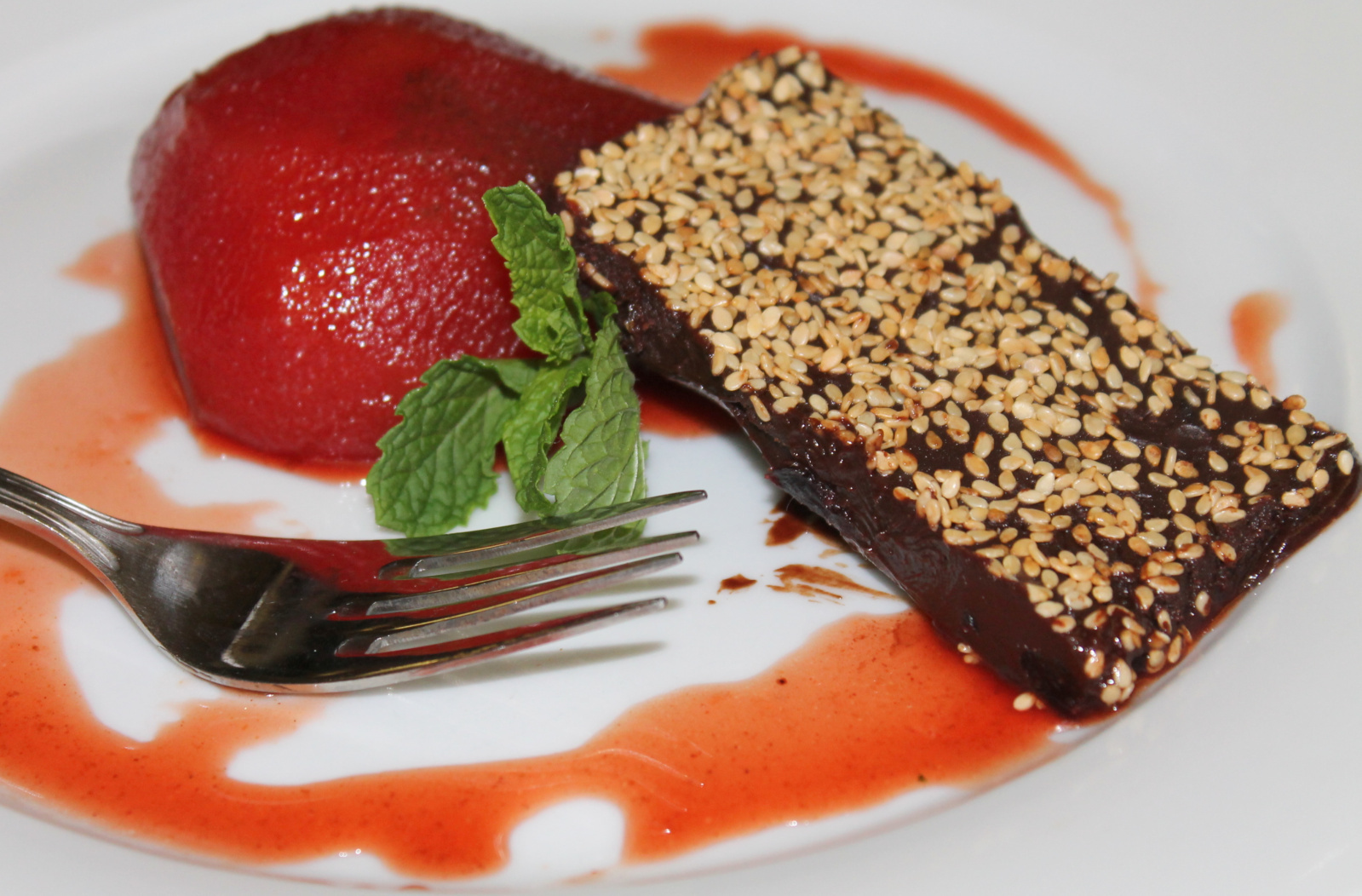
Well, guess what: 10 times each year the BYOB Wine & Dine dinner held at Max’s on Upper State Street does just this. Started by local wine lover Leslie Thomas, they were designed to showcase the diversity of wines from around Santa Barbara. On my visit on a Sunday night Tantara Winery owner Bill Cates (known for his wonderful Pinot Noirs) was on hand and the theme was Syrah. In addition to the Syrahs Bill brought, there were an additional 30 bottles of Syrah to sample: a tall order, but one I gladly accepted. And that’s the beauty of this format. You can contrast and compare Syrahs form multiple producers (there were lots of Syrahs from Santa Barbara, Paso Robles, Monterey and Washington State and some I never got to because frankly there were so many). To start the evening off there are assorted paired cheeses from C’est Cheese, the single best cheese shop in Santa Barbara. That was followed by three courses that Max’s staff prepared including an Herbed Gnocchi with Green Olives, Cippolini Onions, and Roasted Cherry Tomatoes, followed by a Cassoulet of Braised Lamb with Cannellini Beans, Chard, and Stewed Tomatoes, and finally the night wrapped up with a Wine-Poached Pear with Dark Chocolate-Sesame Seed Bark, which was served with a late harvest wine from Tantara.
The staff at Max's prepares the meal
Yes, it’s a lot of food, a lot of wine and a lot of fun. Some in attendance are well versed with wine, others are relative newbie’s, but the common denominator is a love of wine with out all the stuffy pretentiousness. There is a small educational component, but this is not a formal class-room setting, so if you want to talk with the winemaker or owner, if have access to get more detailed if you want. So if winemaker dinners are new to you, or if you want a casual environment to sample plenty of wine specific to the theme of that evening, then definitely consider the BYOB series at Max’s. These are also great dinners if you are visiting for only a few days, or if you’ve lived here for decades. 

They run from 6 p.m. to about 9 p.m. and I highly recommend it. Check out their website under events for upcoming dinners. Max's restaurant

Wednesday, September 26, 2012

Merlot in Monterey & Cabernet in Carmel? The Wines of Monterey County


People come to Monterey and Carmel to absorb the beautiful rugged coastline, visit Cannery Row, and the Monterey Bay Aquarium, but the wine culture here is thriving. Though the county is best known for the Santa Lucia Highlands, where high-end Pinot Noir and Chardonnay are being made, there is an incredible diversity of wine being produced here from Zinfandel to Albariño. So if you’re the adventurous type you’re in luck. I recently spent a week in Monterey Country immersing myself in the wide breadth of the wines.

This is merely an overview of what you can expect.

The first commercial grapes were Chenin Blanc planted in Chalone in 1919 and they are still there. Chalone Vineyards makes Chenin Blanc from these very vines. In the early 1920s Chardonnay was planted, but like everywhere else in the country, Prohibition pretty much halted the growth of the wine industry. It wasn’t until the mid 1980s that serious plantings began to emerge. The main tasting areas are:
The original Chenin Blanc vineyard from 1919, lower center

River Road in the Santa Lucia Highlands is that quintessential vineyard experience: you drive from vineyard to vineyard; there are scenic vistas and you’re in the heart of farm country. Of note the views at Hahn and Paraiso are the best and take into account the vines in front of you, the Salinas Valley, and the Gabilan mountain range in the distance. These tasting room hours tend to be more weekend oriented and are working wineries, so check in advance. River Road cuts through the Santa Lucia Highlands and the preponderance here is Pinot Noir and Chardonnay, though not exclusively. You’ll also find places like Wrath and Marilyn Remark offering Syrah and Rhone wines.
Hand harvesting Pinot Noir

Carmel Village has within its small geometric core, half a dozen tasting rooms including Caraccioli Cellars which is located right downtown. Their focus is sparkling wine and they are one of the few to make sparklers in the entire county. Their wines range in price from $20 to $57, and tasting fees start at $5 and head to $15. And Caraccioli is one of the few places open later (Carmel is notorious for rolling up their sidewalks early) so you can sample a sparkler made from Pinot Noir or Chardonnay before or even after dinner and grab a small bite of popcorn, bruschetta or a cheese plate. The great thing about downtown Carmel is you can walk to all the tasting rooms, hit some shops, and find lunch and dinner all within close proximity.

The Carmel Valley located inland from the seaside village, is awash with wineries and tasting rooms numbering a dozen currently. “The Row” a slice of seven tasting rooms in a long row is the sister to the number of vineyard properties and stand alone tasting rooms which increasingly populate the warmer valley region. Many of the white wines from this area have a more noticeable acidity and minerality which I find best expressed in a new winery called Silvestri, who make wines ranging from $20 to $40, and with a mere 3,000 cases they embody “boutique” ideals here. Their Pinot Blanc and Chardonnay deviate from the standard offerings precisely because of a minimal use of oak and letting the grapes retain their acidity. But Carmel Valley wines, including hearty reds like Cabernet Sauvignon, Syrah and even Merlots which can be surprisingly balanced, though somewhat lacking on the finish. Nonetheless the valley, which first saw Cabernet planted in 1983, is capable of turning out very good though wildly different iterations of these reds.
Sabrine Rodems of Wrath Wines

Some of the most intriguing wines however are coming from Sabrine Rodems of Wrath, and Ian Brand who makes wine for Pierce Ranch, Coastview and his own label. They are indicative of a no-holds-barred attitude of experimenting with whole cluster fermentation, new grape varieties, and finding oddball vineyards with massive potential. Another great discovery is Marin’s Vineyard based in the southern part of Monterey County near Jolon. Small unassuming and well priced, this 800 case winery is doing a remarkable job with Cabernet Sauvignon, Syrah and Viognier. Also located in the southern end, but with a tasting room near Cannery Row, is Pierce Ranch who makes what are called Iberian varieties; Albariño, Touriga even a wonderful classic California Zinfandel. And don’t be surprised on your travels if you see falcons or owls above the vineyards. These incredible birds are employed to keep other birds from eating grapes off the vines.
Louise is a Eursian Owl


And of course wine needs food: some of my personal favorites include Manduka and Grasing’s in Carmel, Passion Fish in Pacific Grove, and the Sardine Factory, The Duck Club Grill, and Restaurant 1833 all in downtown Monterey. Regardless of where exactly you spend your time, you’ll find a vast selection of diverse wines. So always drink local and always try something new; you’ll see Monterey Country in a whole new light. And when you do, post a comment on this blog and let us know what you like and don’t like! 

And be sure to check out my 2 Minute Travel video shot at Hahn Winery:


Plan Your Trip