Friday, May 30, 2014

The Serious Side of Paradise: Santa Barbara’s Missing Kids


  This blog is about the happy aspects of traveling to the California Central Coast: Santa Barbara, San Luis Obispo and Monterey. But that doesn’t negate the seriousness of the article I wrote originally for a Santa Barbara newspaper for National Missing Children’s Day. My hope is that any of you who read this, regardless of where you are in the world, will be more aware and attuned to this global problem – our kids who go missing. Please share this information – and be mindful of what is happening in your community. Please.

It’s a sad commentary that we even have a National Missing Children’s Day - May 25th - but we do. Every day in the U.S. approximately 2,300 children under the age of 18 go missing, most voluntary, but many not. It’s estimated that 200,000 children annually are abducted by family members, and 58,000 are abducted by non-family members. The recent kidnapping of over 200 Nigerian girls by Boko Haran has highlighted a staggering problem not only across the globe, but right here in Santa Barbara. Our kids are at risk: from abduction, online predators, and physical sexual abuse which often is the root cause for kids to go missing in the first place.

Tim Hale is a Santa Barbara based attorney with the firm of Nye, Peabody, Stirling, Hale & Miller, LLP who represent victims of childhood sexual abuse in lawsuits against individuals and entities including the Catholic Church, the Boy Scouts, and public and private schools that have either failed to report or have actively tried to cover-up sexual abuse committed by their employees and volunteers. He knows firsthand the devastating effects our kids suffer. “Every child reacts differently - some withdraw and shutdown emotionally, some act with anger, sometimes with inappropriate sexual behavior, sometimes with self-medication through substance abuse,” he says. “Our lawsuits seek not only a monetary recovery for our clients’ injuries, but also the public release of a perpetrator’s personnel file where his employer’s cover-up has allowed him to escape criminal prosecution, rendering him unidentifiable to the public as a threat to children,” says Mr. Hale.


The point is not to live in fear, but to live wisely, to educate our kids and ourselves so we can mitigate those threats. According to the California Department of Justice, in 2011, (the most recent statistics available) there were 958 reports of missing children in Santa Barbara County alone: 908 were reported runaways, 17 were reported lost, 12 were reported family abductions, five were “suspicious circumstances,” and 25 were unknown circumstances. In California, more than 90,000 children were reported missing that year. In 2013 there were nearly 495,000 missing persons under the age of 21 throughout America. Actual numbers of missing children is something of a moving target. Some children go missing due to natural disasters, some are voluntary runaways (the vast majority), some are endangered runaways (classified as suicide risk, physical or mental conditions which might cause them wander off, or circumstances where kids fled to or from some danger), and some have been abducted by a family member, or a stranger. According to the National Center for Missing and Exploited Children (NCMEC), an estimated 115 children annually are the victims of the most serious abductions and are either murdered, ransomed or taken with the intent to keep. “The first three hours are the most critical when trying to locate a missing child. Studies indicated that 76 percent of abducted children who are killed are dead within three hours of the abduction,” the NCMEC states. Regardless of the label given to any missing child the Central Coast sees kids go missing in some cases to escape sexual abuse at home, or after a prolonged online “friendship” with a predator.

Online Predators
According to the FBI one in 25 children ages 10 to 17 have received an online sexual solicitation where the perpetrator then tried to make offline contact. “Predators seek youths vulnerable to seduction, including those with histories of sexual or physical abuse, those who post sexually provocative photos or video, and those who talk about sex with unknown people online,” the FBI states. And this is clearly the driving reason parents need to monitor their kid’s social media behavior because with increased sexting (texting sexually suggestive words and pictures), there is the increased likelihood a predator sees this as an easy target. “Boys who are gay or questioning their sexuality are particularly at risk. 25 percent of victims are boys and almost all of their offenders are male,” the FBI says. It seems overwhelming, but being aware of, and admitting, these problems is crucial to the safe-keeping of our kids.

What Adults Can Do
“Every day we hear stories about children who escaped a would-be-abductor because someone talked to them about what they should do in that situation.” says NCMEC’s CEO, John Ryan. “Education and open communication are key to keeping children safer.” Obviously communication is crucial, though it can be difficult. “I can’t say there’s a specific right or wrong way to talk to your kids,” says Mr. Hale. “Every parent-child relationship is different. What I can say is that you need to talk openly and regularly, beginning with younger kids, about the fact their bathing suit areas are theirs and theirs alone, and no one should touch them in those areas except for mom or dad or select caregivers for younger children who still need help wiping themselves.” More often than not these are not crimes of violence, but of emotional manipulation. “It’s important the child understand that no matter how nice a person is being, no matter what they are offering, no matter what elevated status the person has in the child’s eyes, no one should touch the child’s bathing suit areas,” Mr. Hale advises.

With kids who text there is code that has developed, a shorthand language, many parents are clueless about designed to keep texts secretive. For example: “wtgp” (want to go private?); “p911” (parents are coming); “pir” (parent in room); “asl” (age/sex/location) and many others. This covert language can be a clue to what your child is doing. Photos on the other hand are less covert and may seem innocent enough. The website NetSmartz, an on-line resource from the NCMEC, warns: “Posting your child's pictures online could put them at risk for victimization. Using privacy settings to limit access to your children's pictures can help protect them. However, you need to be sure that only people you know and trust in real life are able to see your pictures.” There is no particular way to prevent uploaded photos from being copied. Frankly the only way to ensure no one uses your images is to avoid uploading them in the first place. Even if you use coding to prevent users from right-clicking and saving your pictures, anyone can still screencapture an image, and remember, once an image is online, there is no getting it back.

It’s naive to tell children to think before posting photos when adults don’t understand the potential issues either. So at the very least discuss parameters with your kids: “Personal photos should not have revealing information, such as school names or locations,” NetSmartz advises. “The background of any photo can give out identifying information without realizing it. The name of a mall, the license plate of your car, signs, or the name of your sports team on your clothing all contain information that can give your family's location away.”

What Kids Can Do
Of course it’s not merely what adults can do, but what kids themselves can do. First and foremost they should tell their parents about any unwanted attention, sexual or otherwise, either on-line or from an individual. “Hopefully parents have created an environment where the child feels comfortable telling them such things,” says Mr. Hale. “If telling a parent is not an option, they should tell a trusted adult.” Under California law, most child custodians and caregivers, such as teachers, youth group leaders, therapists, and doctors are mandated to report to law enforcement if they have a reasonable suspicion a child is being sexually abused and a mandatory reporter who fails to take action is subject to criminal prosecution, Mr. Hale advises. Of course many adults don’t want to get involved in someone else’s problem, it’s easier to turn a blind eye, but that only perpetuates the matter. The biggest weakness of parents? “Failing to recognize that anyone can be a perpetrator, that perpetrators more often than not are not the scary looking figure in in the shadows, and openly placing a person on such a high pedestal that a child is terrified of speaking out about them,” says Mr. Hale. The simplest and most obvious rule is the best one. “Perpetrators almost always use secrecy as a weapon, therefore families need a policy of no secrets,” says Mr. Hale. If nearly 1,000 Santa Barbara kids go missing each year, we need to be more vigilant. We have the power to help keep our kids safe, and it’s up to us.


Missing Children’s Day Timeline
May 25th, 1979: Six year-old Etan Patz goes missing in New York. He has never been found.
1979 to 1981: 29 children are murdered in Atlanta, all the result of one man.
1981: Six year-old Adam Walsh is abducted and murdered in Florida. His father, John Walsh, forms the first center for missing children, later hosts America’s Most Wanted.
1982: Congress enacts the Missing Children’s Act.
1983: National Missing Children’s Day first observed by proclamation of President Reagan.
1984: National Center for Missing and Exploited Children is founded.
1996: Amber Alert begins. As of April 2014, 688 missing children have been successfully recovered.
2004: Violent Crimes Against Children Task Force (FBI) is formed making it the largest task force of its kind in the world incorporating 40 participating countries.

Resources 
National Center For Missing and Exploited Children 
FBI
California Child Abduction Task Force
NetSmartz

Saturday, April 26, 2014

Treatament to Tap: Santa Barbar's Water Route


You may be a local, you may be a visitor, but how our water in Santa Barbara gets to our taps, to your hotel and restaurants is something most folks never consider. So CervnsCentralCoast paid a visit to one of Santa Barbara’s water treatment plants, the Cater Treatment Plant to uncover just how Santa Barbara and other similar cities get their water – it’s an inside look that few get to experience.

Inside and underneath the plant, water moves through color coded pipes
Every city has a water resources division who collect, clean, store and distribute our water. Moving water around seems like a simple process, but it is a complicated, highly refined system. To begin with Santa Barbara, like all of Southern California, is a semi-arid climate and though we are populated with trees and the Pacific Ocean gleams in the distance, we are not a water rich area. Cater is what’s known as a surface water treatment facility, obtaining its water from Lake Cachuma over the mountain, located in the Santa Ynez Valley. The water leaves Lake Cachuma through an intake tower which connects to a 6.4 mile-long tunnel underneath the Santa Ynez Mountains, then connects to the South Coast Conduit which conveys water to the Cater plant, all done by gravity flow. Water of course is a finite resource and it costs money to transport and clean water for public consumption.

Process
Untreated surface water has a slightly negative charge so a positively charged coagulant chemical (aluminum chlorohydrate) is added which neutralizes the charge. An added polymer helps bind and adds weight to the suspended material in the water, so the tendency for water particles to push apart has been reduced, and they now clump together, known as coagulation. The water is put into a flocculation basin (really big paddle mixers turning very slowly) causing additional particle collisions, thereby making any suspended material in the water, algae and silt for example, heavy enough to drop to the bottom. Ozone disinfects the raw water at the beginning of the treatment process which helps oxidize dissolved minerals like iron and manganese, and conditions the water for a more efficient treatment process.
The flocculation basins

Then the water moves into a sedimentation basin where a large squeegee-type device rakes the heavy particles towards an auger which is removed to three solid recovery beds where the suspended materials dry naturally using sun the ambient wind. Once fully dry it looks like fine black dirt, and it’s stunning and slightly disturbing to see visually what has been removed from our water. There’s also a filtration system whereby the water percolates through 30 inches of carbon, then a foot of sand. Chlorine is still widely used in many water utilities and Cater adds chlorine at the very end of the treatment process to provide a “disinfectant residual” mean it helps kill of bacteria as it journey’s through the pipes towards the tap.

Water samples are routinely collected at the plant and run through multiple panels monitoring for turbidity, chlorine and bacteria, among a host of other things. Eventually the clean water is held in a “finished water reservoir,” ready to leave Cater and snake its way through a series of labyrinthine pipes. Cater processes an average of 18-20 million gallons of water per day.
 
Left to right the solid recovery basins and with the dry solids left over from treated water
Distribution
Underneath your feet, regardless of what city you’re in, is a maze of hundreds of miles of pipes. These pipes are monitored constantly because a break in an underground pipe means the possibility of bacteria getting into the water supply. Additionally, pipes do not last forever, but out of sight, out of mind, right? Added to that is that certain soils have corrosive effects therefore pipes need to be replaced. Every city, including Santa Barbara, has a replacement goal for aging pipes to prevent any issues with our water becoming contaminated, but pipe replacement is a time consuming and costly endeavor. Blacktop needs to be pulled up, roads closed, repairs made, water needs to be rerouted and occasionally shut off, not to mention that residents don’t like to have detours on their way to work. But replacement is necessary. Without it, you might not have the water you expect.

Water sources need constant protection
Water Wisdom: Conserve and Preserve
Conserving water is a lifestyle choice. If the idea of using water wisely doesn’t create motivation for you, perhaps your cost savings will. Like it or not water costs are rising. Here are some easy, simple steps to employ, not only at home, but everywhere, helping to reduce your water footprint.

--Time your showers. The average shower uses 2.5 gallons of water per minute. How long do you lounge in the shower and how much water is used? Time yourself, you might be surprised.
--Use drought resistant landscaping. If you have traditional landscaping water your yards at night which allows the water to absorb more fully into the ground. Watering in the morning means the sun evaporates what you’ve just put on your grass. You will use less water and save money.
--Stop watering sidewalks and driveways. Far too many people, whether at home or at their place of business hose down their sidewalks. Grab a broom, burn a few calories and don’t waste water on concrete.
--Practice rainwater harvesting. In my house this is no more high-tech than letting the roof-gutter water fall into a plastic trash can. Then use that water for your fruit trees, herb garden, etc. You can get fancy with rain chains, but it’s simply about capturing rainwater and the bulk of rainwater is best accessed from your downspouts.
--Get involved in beach clean-up days and creek rehabilitation. We say we value our beaches, but they are constantly littered. The more we are attuned to the health of our creeks and ocean, the more likely we are to respect our water.
--Practice water conservation when you travel. Most hotels give you the option of not washing your bath towels and bed linens on a daily basis.

By respecting our water we keep our rivers, creeks and oceans clean & healthy!


Thursday, March 27, 2014

The Granada Hotel Goes SLO


San Luis Obispo (known as SLO for short) is one of the coolest towns along the California Central Coast. South in Santa Barbara you have wine and waves and north in Monterey you have rugged rocks and the Bay. But SLO is set inland, 8 miles from the beach flanked by the low rolling hills and dormant volcanoes. Historically filled with a mix of B&Bs, chain hotels and a few family-owned spots, it has always lacked the kind of lodging with a mix of hip and trendy with historical cool…until now.


The Granada Hotel & Bistro has opened its doors. Originally built in 1922 and operating as a hotel, it was located next to a theatre and was thought to be part of the red light district. Regardless of that tidbit, there is a speakeasy feel to place, a nod to the roaring 20s. Today the Granada has the only rooftop lounge in San Luis Obispo. In the mornings from the trees that front the building you can hear flocks of black birds carrying on, a happy, natural wake-up call. During my stay I stood out on the second floor balcony not only watching the birds, but the slow steady rhythm as day began and the ever-increasing people began to move about this compact city.
The Granada Hotel is all about the moody details

The Granada succeeds because it is cool and hip without trying to be cool and hip. The attention to detail with rich hardwoods, exposed brick walls and small noticeable elements like door handles, and light fixtures are all perfectly suited for this space. It creates a blend of vintage with an almost European sensibility. Upstairs the rooftop lounge has an outdoor fireplace, a perfect spot for the morning coffee ritual. Nearby a small blue phone on the telephone table allow guests to order something directly from the bistro downstairs, like it’s your personal Bat Phone. The rooms here are small; “intimate” would be the word used by the hotel, and they are that, but they also feel just about right with an intelligent design for the space to maximize the room. The accompanying bistro located on the first floor has original tin pressed ceilings, a small bar, a large communal table and a terrific outdoor patio for day or night dining. This is quite honestly the nicest property in all of San Luis Obispo to stay.


There is also the Art Bar located next door. Wine, beer and charcuterie ($40) are provided in a two-hour class where you can tap your inner artist. Local artists guide you through a version of their own painting and though you may imbibe the wine, no one will judge you on the outcome of your painting, even if it looks nothing like the original. There is also a small spa on site and given the roped off access and dark curtains to keep non-guests at bay, you feel as if this is your own private club.

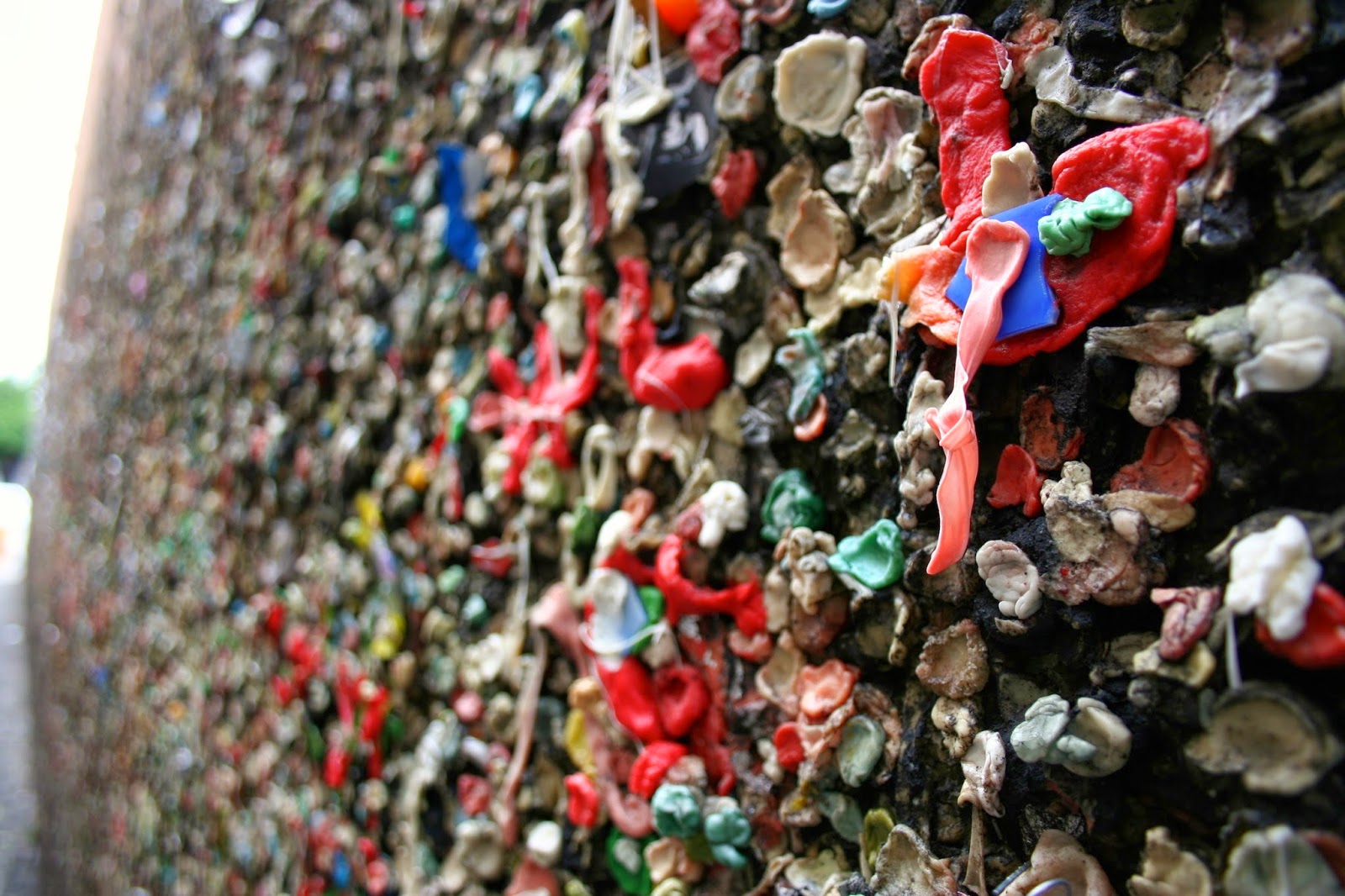
Bubblegum Alley is a must see.
And of course, you’re right downtown a few steps off Higuera Street so you can walk to most everything. A few additional things to do: check out Bubblegum Alley (700 block of Higuera Street) a sticky, if unusual, landmark. It doesn’t resemble anything but what it is; tens of thousands of wads of multicolored gum rejects squished one on top of another in a masticated mosaic some 70 feet long and 15 feet high. It is urban pop art, a unique expression of individuality in the form of chewing gum. Some people seek to make a statement, spelling out their love, their hopes, or merely pressing tasteless gum onto a wall. Some find this disgusting, but it is modern art in gum form, yes, used art, as it were. There are gum dispensers on either side of the alley and for a mere 25 cents, you can add your chewed up message to the ages. Don’t pass by and pass judgment, walk the alley and observe.
The author at the summit of Madonna Mountain

And take a hike up Madonna Mountain for awesome 360 views which will take you an hour to reach the top, and in spite of the hike being all uphill, it’s worth the effort to have so much of the Central Coast splayed out before you. So consider SLO as your next destination, but book the Granada for your lodging. 

Check out my post on the San Luis Obispo Mission, close to the Granada here: MISSION SAN LUIS OBISPO

Thursday, February 13, 2014

Of Missions, Meat & Movies: Mission San Luis Obispo


Mission San Luis Obispo de Tolosa was named after Saint Louis (no, not the city) who was the Bishop of Toulouse in France and was founded in 1769. Let’s stop there. “Founded” merely meant a prayer was said, a cross stuck into the ground and that was pretty much it. The Spanish who controlled California used the chain of missions to not only bring religion to the New World, but the missions acted as trading posts in the once rugged and desolate California landscape.


But hang on. Why here exactly? On September 7 and 8, 1769 Gaspar de Portola and his expedition traveled through San Luis Obispo on their way to the Monterey Bay. The expedition’s diarist, Padre Juan Crespi, recorded the name given to this area by the soldiers as “llano de los Osos” or the “bear plain,” as there used to be a whole hell of a lotta bears here. In fact, Los Osos, just west of San Luis Obispo, still holds that name.
 
Father Serra and the SLO Mission
Skip forward to 1770 and Father Serra founded Mission San Carlos Borremeo in Monterey (it was moved to Carmel the following year.) As the Monterey mission’s supplies dwindled in 1772 soldiers, padres and Native Indians faced starvation. Remembering the bear plain where they had stuck a cross into the dry earth years before, a hunting expedition was sent to San Luis Obispo to bring back food in the summer of 1772. Over 25 mule loads of bear meat was sent up coast to the Carmel Mission. It was after this that Father Serra decided that San Luis Obispo would be the ideal place for a fifth mission. The region had abundant supplies of food and water, the climate was mild, and the local Chumash were very friendly, until, you know, they were enslaved. Given these conditions, Father Serra set out on a journey to reach the bear plain and on September 1, 1772, he celebrated the first mass near San Luis Creek.

After Father Serra left, the task of building the mission remained which was accomplished primarily by the hard work of the local Chumash Indians – as in cheap labor. The church and priest's residence were built by 1794, and other structures made up the primitive mission in the early days, namely storerooms, residences for single women called a “monjerio,” barracks and a few
A photo of a photo, but historically cool
mills. The mission also used the land for farming and raising livestock since all missions depended upon whatever they produced for their survival. Expansion proceeded for a few years due to the prosperity of the mission, but those days were numbered and Mission San Luis, like all the other missions, gradually fell into disrepair in part because Spain stopped sending money to fund the California missions. When Mexico won independence from Spain in 1821 the missions were “secularized,” decommissioned as it were, and often mission lands were sold off. Governor Pio Pico sold the San Luis Obispo Mission to Captain John Wilson for a mere $510 in 1845, about $15,500 in today’s dollars, still a seal (though the actual church was not included in the deal). The building served multiple functions, even as a jail and the first county courthouse. It was returned to the Catholic Church in 1859.
Still an active church the mission is open daily

Today the mission fronts Mission Square (where parts of the Sandra Bullock film, Murder by Numbers was shot – no pun intended) facing the creek, and Higuera St. The courtyard is a popular place for small gatherings and festivals. The interior of the mission is minimally decorated, mainly hand painted. The whitewashed interior walls of the church are enlivened by a brilliantly hued “vine of life,” a reproduction of the original decor. The original floors were packed earth back in the day, colored red with cinnabar. Now of course it’s colored concrete. Still an active church, mass is held each day at 7 a.m.


A visit to the mission museum will set you back $3, and it’s worth the cost. The original mission doors are located, ironically, inside the museum on display and were used up until 1948. The museum is surprisingly large but it’s not all mission era stuff on display here. There is a good number of Indian artifacts; bowls and baskets, jewelry, pottery arrowheads and abalone shell pottery. There are mission-era vestments the padres wore, church artifacts and early 19th century clothes and personal belongings once the Westerners moved in to this region There are quite a few adobe cut-outs so you can see the exposed brick. The outside gardens are intimate with a water-well located center overlooked by Madonna Mountain. Clearly modernized landscaping with little green lawns does not reflect what it actually would have looked like and the mission itself is surrounded by Australian Eucalyptus trees.
A lonely portion of one of the original walls

For you true history buffs, walk across the street to the historical society building and there, barely seen or known about is part of the original mission wall – just a small chunk of authentic history waiting for someone to notice it. (MISSION SAN LUIS OBISPO, 751 Palm St., San Luis Obispo, 805/781-8220)

Wednesday, December 18, 2013

Santa Barbara’s Best New Restaurants for 2013


I eat for a living. As the restaurant reviewer for a Santa Barbara newspaper for seven years I eat…a lot. I get to travel and sample foods from various countries and judge at food and wine events, so I’m always near food, thinking about food, eating food or wondering about my next food. About 40 restaurants opened in 2013 and many are forgettable; many are good, but only a few fill a void with unique, creative food, service and ambience. So listed in alphabetical order are my favorite spots which opened in Santa Barbara for 2013. Check them out!


Georgia’s Smokehouse Here’s the truth – Santa Barbara sucks for BBQ, until this great food truck rolled into our lives. Stunningly tender ribs, pulled pork and spot on sauces proves that a food truck 
can be flat out awesome. Try the Bacon and Cheddar Hush Puppies, delightfully crisp deep-fried 
balls of dough mixed with cheese and bacon and topped with sea salt, seriously that’s a no-brainer. 
Their Smoked Burger is topped with whiskey-caramelized onions and roasted tomatoes with 
clean and focused flavors and a hint of sweetness. The Smoked Baby Back Ribs are wonderfully 
fall-off-the-bone tender ribs coated with a tangy vinegar-tomato sauce that has great citrus and heat. 
805/845-4854, GEORGIA'S SMOKEHOUSE

At the Paso Robles Winemaker's Cookoff judging competition


Paloma Mexican food goes where it should have gone years ago – out of the dull realm of tacos and beans, and into seasonal South American dishes with spicy sauces and real flavor. You must order the Chile en Nogada, a Pasilla chile stuffed with walnuts, pine nuts, ground beef, peaches, spices and topped with a creamy, slightly sweet sauce and dotted with pomegranate seeds. A seasonal dish from Puebla Mexico, this offers a great balance of heat and texture. The Enchiladas Paloma is a shrimp and cheese enchilada topped with a creamy chipotle sauce that actually has a potent roasted smoky quality the way chipotle is supposed to be. Oh, and there are 100 tequila’s for your consideration…woo hoo!

5764 Calle Real, Goleta, 805/681-0766

Monday - Friday 11 a.m. to 10 p.m., Saturday & Sunday 9 a.m. to 10 p.m. PALOMA

The real deal- Greek salad in Crete.

Sama Sama Not familiar with Indonesian food? Great – here’s your intro. They use rotating local farms where they get their vegetables. The foods are simple and rustic but loaded with flavor and finesse including the Tempe Rice Bowl of sweet soy glazed crispy tempe, mixed with coconut rice and topped with a gado-gado salad of thin sliced cucumber, zucchini then mixed with a peanut dressing. Hands down, one of the best vegetarian dishes in town. The Nasi Goreng is fried rice mixed with diced carrots, celery, garlic and broccolini with a fried egg on top and then dusted with green onion, and served with shrimp crackers. Uncomplicated but very gratifying food. 1208 State St., Santa Barbara, 805/965-4566

Tuesday - Friday 11:30 a.m. - 2 p.m., & 5:30-10 p.m., Saturday 5:30-10 p.m., Sunday 10:30 a.m. - 3 p.m.  SAMA SAMA


The best Caesar Salad I've ever had in Tijuana!
Seven is located in the hip, new, trendy Funk Zone and this under the radar spot, really a bar with killer food, is as unpretentious as it is hard to find. No address, no signage – they think it’s a cool like that. It’s actually annoying, but forgive that (and the weak service) and go for Chicken and Waffles with infused maple in the chicken, their Cali Slaw (an awesome riff on Cole Slaw featuring herbs du Provence, or any of their sandwiches (named after the seven deadly sins) and yes, their mouthwatering pulled pork sliders. Simple bar foods done exceptionally well! They have a back patio, exposed brick interior, some cool cocktails and rotating art. 224 St. Helena, Santa Barbara, 805/845-0377, Monday - Friday 5 p.m. - 1 a.m.,  Saturday & Sunday Noon - 1 a.m. SEVEN


The Lark is named for an overnight Pullman train that serviced Santa Barbara for 60 years. Their Caramelized Cauliflower Gratin is an instant classic with texture, heat and spice. Gruyere cheese is mixed with preserved lemon, chili flake, bacon, breadcrumbs and cauliflower, then baked - absurdly wonderful. The Roasted Mary’s Chicken is brined then air-dried making it extraordinarily moist, served with brown butter polenta, butternut squash, and a maple Sherry chicken juice. Crispy Brussels Sprouts are a mix of Medjool date, sesame, lime, and garum for a savory element. The result is a dish of great balance and texture, with a sweet note as a counterpoint to the vegetal sprouts.

131 Anacapa, Santa Barbara, 805/284-0370,

Tuesday - Thursday, & Sunday 5-10 p.m., Friday & Saturday 5-11 p.m. THE LARK

Me and the Mrs chowing down in Innsbruck,  Austria


Toma sits in the former Eladio’s spot near the harbor and this is an absolute gem. Love, love, love the Tuna Cones which are comprised of diced ahi sashimi, ginger, sesame, soy, chile, and chives stuffed into a crisp sesame seed cone - think of this as an ice cream cone for adults. Also excellent are their pasta dishes, grilled romaine salad, and braised short ribs, frankly it doesn’t matter, it’s all so damn good with exceptional service – a shortcoming of far too many restaurants everywhere. 324 W. Cabrillo Blvd., Santa Barbara, 805/962-0777

Nightly 5-10 p.m. TOMA

And be sure to read my weekly reviews every single Friday in the Santa Barbara News-Press to see what's what in the culinary world here. I cover everything from high-end to holes-in-the-wall.